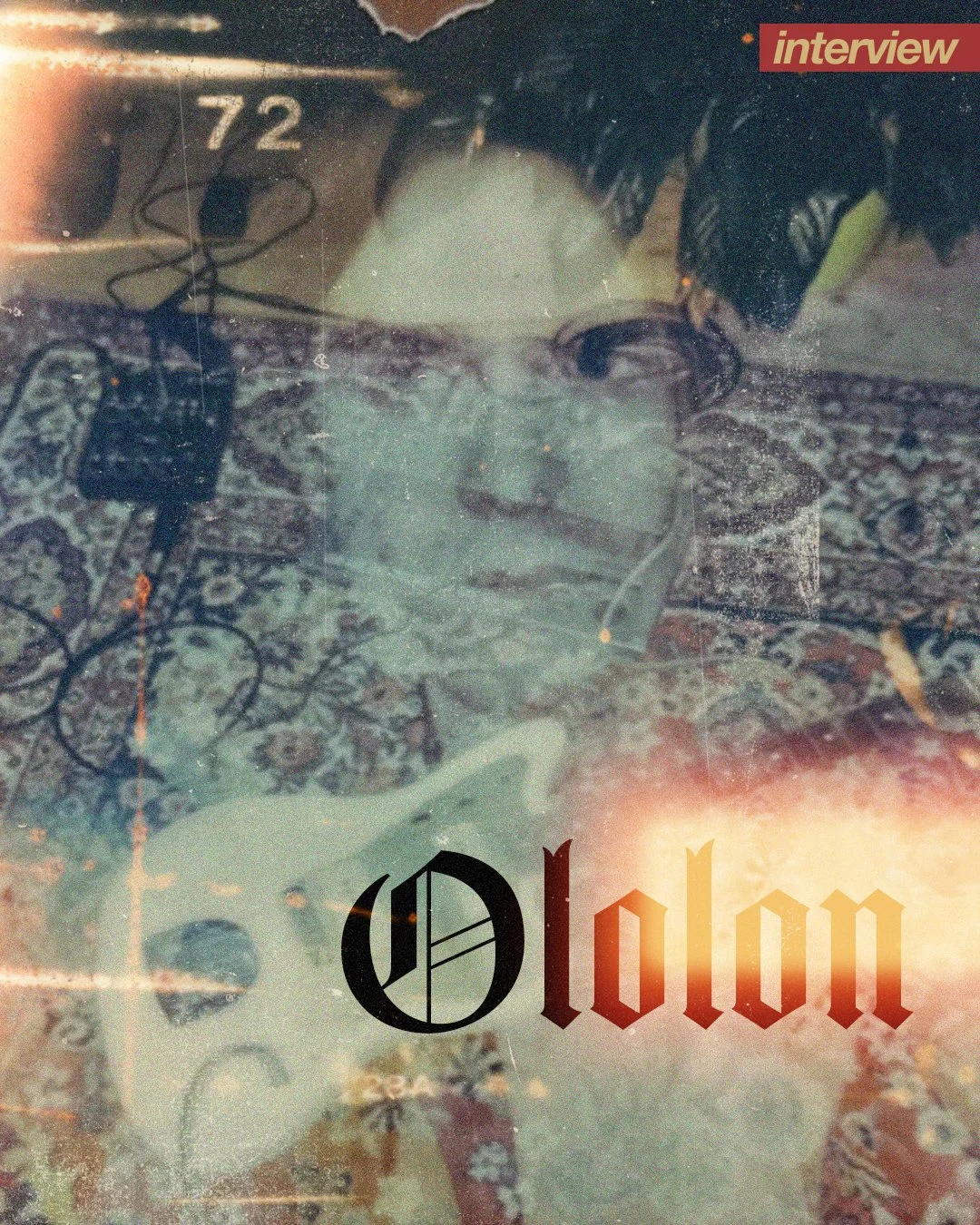
Not a lot is known about Oliver Sanchez and his mysterious music, so we sat down with him to dive into the unique world inside his songs and how he creates them.

Photo: Oliver Sanchez
Music is a magical thing. Anybody can play it. For something so accessible and ubiquitous, its ability to find its way into our hearts and heads is nothing short of a gift. With music creation becoming so democratic in the twenty-first century, it’s easy to find yourself lost amidst the millions of music makers online. It’s easy to find exciting music to listen to. Anyone who argues that any kind of music is dead is, well, simply not trying hard enough to find it. What’s not so easy, however, is to find someone who is making genuinely unique, innovative and interesting music. Step forward Ololon, real name Oliver Sanchez.
Raised in Cheshire but with a Spanish father, Sanchez is a bit of a musical mystery. He has several eclectic home-recorded releases online, yet very little is known about him personally. In the modern world where an artist’s personality is often as marketable as their melodies, Sanchez is only really interested in one thing: music. He says that he “was always very musical as a child” — however, one of the many things that makes his story so uniquely interesting is that he had no technical musical experience until much later on in life.
Sanchez remembers he “started with electric guitar because I had one when I was a kid, but I was never very good on it but, when I was seven, I started properly trying to figure out how to play chords.” After that, he gradually picked up bass and keyboards. Learning to play music was more a vehicle to get to the act of actually creating music than anything else. Sanchez recalls that he “didn’t have any sort of inherent talent on any instrument” but rather that he would be keen on just “making songs.”
As opposed to technical virtuosity, what Sanchez leaned more towards was something much simpler: words and melodies. He says that some of his “earliest memories is just listening to what my dad would play in the car. A lot of The Cure and The Smiths.” Whilst a technical pursuit of music wasn’t particularly interesting to Sanchez, he found early on what he did have “more naturally was a flair, I guess, for writing.”
He discovered poetry and his favourite writer, William Blake. What followed was an intention to combine his literary talent with his pure love of music. Combining these two loves “opened the door for where I could connect my little music with concepts and world building.” Just like that, Ololon was born. The name is taken from, perhaps unsurprisingly, “a made-up word from William Blake.”
One of the key ideals that Sanchez is passionate about is his desire to maintain control over his music and to record it all himself. He has played in bands when he was younger but “didn't really enjoy it because sometimes you just don’t get listened to in a band or sometimes you find it really challenging to work with someone else.” He decided that pursuing music on his own terms was the best option. Ultimately, though, he felt that he “had no other option to do it that way.”
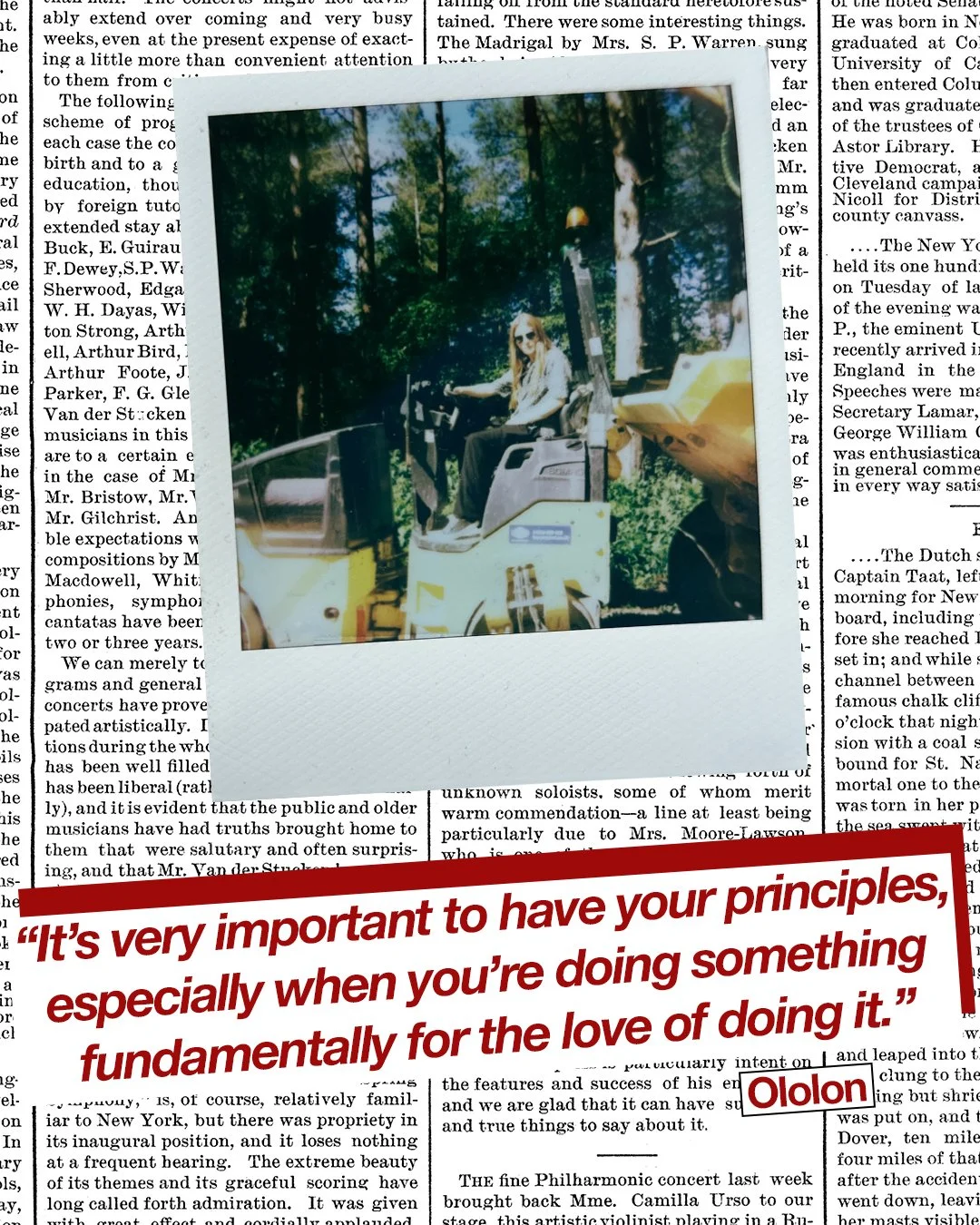
Sanchez is fiercely idealistic in his approach to music; he writes, performs, records and releases it all himself. It’s a real throwback to the ethos and heart of indie, punk and alternative music. “It’s very important to have your principles,” he tells me. “Especially when you’re doing something fundamentally for the love of doing it.”
Similarly, Sanchez is a staunch defender of the album as the most captivating medium for making music. It’s why, aside from a Christmas EP he admits he did “because I thought that was funny”, all of his released music comes as entire, fully realised albums. He says he became “really passionate about the album as an art form” when he was a teenager and has never looked back since. He added that he likes “to lay out albums with a side A and a side B, like I’m doing that on purpose. I could do individual singles, but I’m not interested in that.”
It’s refreshing to hear somebody so uncompromising in their love and approach to music. Speaking to him, it’s abundantly clear that music is special to him and it should be treated as such.
Oliver is a huge fan of home-recorded, DIY music such as “the godfather of home recording, Stevie Moore.” Sanchez himself is an ardent home recorder and records all the parts to his songs himself in his home studio — if you can even call it that, of course. He’s keen to stress that his recording setup is simply just him in his shed outside. Most of his music gets recorded using a Tascam 414 4-track machine to “get that distorted and tape warbled sound.”
In favour of expensive gear or treated rooms, he often prefers to “direct input where it's just straight through in the machine instead of micing an amp or anything because I’m not interested at all in a pristine sound or locking into a grid.” It all starts with a song and once written, he will then “get the guitar down first and double track that or I’ll mess around and come up with what kind of fits on top of that.” What follows is “just overdubbing really. Usually, the bass is one of the last instruments.” Sanchez adds that “people think it’s weird because a lot of the time I will play the song all the way through. I won’t stop it and then start it to go again.”
When it comes to recording drums, he’s keen for his electronic drums to sound as human as possible. He tries to “program them in a way that sounds like a human could play it. I tweak the timings of them so it’s slightly off and kind of detune them a little bit, just so it gives it that saturation and that warmth.” He adds, “I try and do these little tricks to make it seem like it’s an actual band playing, instead of just me. I want it to sound like it’s something that you can’t contain.” Uncontainable is certainly an apt description of a lot of the music Sanchez has released thus far.
This DIY ethos is part of his incredibly organic and pure love of listening to, making and recording music. He’s determined to show that anyone can — and should — make music. As for the music itself, it’s certainly off the wall. You could use adjectives like chaotic, bizarre, wild and unique. Really, it’s best to go and listen to it for yourself. It’s not an experience you will regret.
His favourite music is music that “even though it’s kind of like out there or noisy at the foundation, it’s pop music.” It’s no different with his own music. Beneath the droning noises and disjointed rhythms are songs designed to be fundamentally catchy, memorable and hooky. His latest album, Fazu’ulian Exiles, sounds like someone’s Casio keyboard is glitching and spilling sounds out all over the place. It’s chaotic in a primal and genuinely exciting and interesting way. It’s an absolute hurricane of sounds and sonics firing off in all directions.
Perhaps most interestingly, Fazu’ulian Exiles isn’t just a collection of chaotic songs; it takes the form of an incredibly lyrically dense concept album. If you thought Sanchez’s music was ambitious, then brace yourself because his lyrical and literary ambitions are even grander in scale. The album explores the “whimsical world of Fazu'ul and imagines what those must be like to be exiled from such a strange place.” It’s part two of a trilogy that began with his previous record Oximia'ades Nepos & the Fasijik College of Fazu'ul.
If you’re wondering where on earth these ideas could possibly come from, then you’re probably not alone. Sanchez recalls, “I was visiting the Lake District at the time, and I got really sick and had a fever and, for some reason, this idea came to me about a character called Oximiada getting transported by a space god to another world.” He says the general story is “really inspired by Blake’s illuminated works” and that it’s a “surreal mythology.” He’s keen not to take things too seriously and makes sure to stress that music and writing are never anything other than fun and a chance to blow off some steam in his spare time.
Of course, you don’t need to follow Fazu’ulian Exiles like it’s a novel to understand it. Sanchez does a fantastic job of making sure the songs are enjoyable at face value whilst giving more ardent listeners plenty to chew on beneath the surface. Regardless, Sanchez is never not moving forwards and working on something. He’s currently working on the final act of the trilogy with a working title of Triple Tau. He says the album is going to have a “more minimal sound” as well as being a “shorter album as well with a very different vibe.” He adds that he wants to show that he “can actually write, you know, quite tight songs.”
Production-wise, it’s far less chaotic, with a focus on dynamics and gradual builds. He describes that “I want it really minimal to see if it would still be compelling without all of the chaos. By stripping it back, when there are elements of even just the smallest bit of chaos, it sounds way more chaotic.” As ever with Sanchez, he’s keen to stress that “at its foundations, it's another pop album.”
Outside of finishing his trilogy, Sanchez would also love to explore performing live more often. It’s something he hasn’t done much of over the years due to being so busy recording and finding it difficult to translate his dense and spontaneous recordings into songs that can be performed easily live by just himself. It sounds like his upcoming music will be more straightforward to perform live, and it’s something that Sanchez is looking forward to.
Unsurprisingly, Sanchez isn’t interested in any side of music that isn’t simply writing, recording and performing. If he needs to compromise his core values in order to play live or be heard by more people, then he simply isn’t interested. He mentions the endless cycle of self-promotion on sites like Instagram and makes it clear that “I’m not interested in that. I want to make music and, if the opportunity to perform is on the table, then I’m going to do it.”
At the end of the day, Sanchez is just another music lover like you and me. He concludes our conversation by saying that “I’ve never been inspired by anything as much as music and I just want to channel that.” He adds, “I definitely think it comes from something higher than myself and I’m more than pleased to be a conduit for that.”
Wherever his music comes from, it’s exciting to hear somebody who isn’t afraid to make music on their terms for themselves and with no care or preconception of what might happen with it afterwards. Listening to Ololon, on the one hand, is to celebrate the democratisation of music but, more importantly, on the other, it is to rejoice in the purest form of joy music can create.
Perhaps Sanchez put it best in our conversation when he said that “it just has that ability to completely take who you are as a person and change and inspire you.” Music certainly changed Oliver Sanchez’s life and, if you give his music a listen, I think you’ll end up feeling pretty inspired too.
Triple Tau is out now.