
Searows releases captivating new album ‘Death in the Business of Whaling’
The Portland-based artist uses literary and film references to create a world that’s both fantastical and all-too-real.
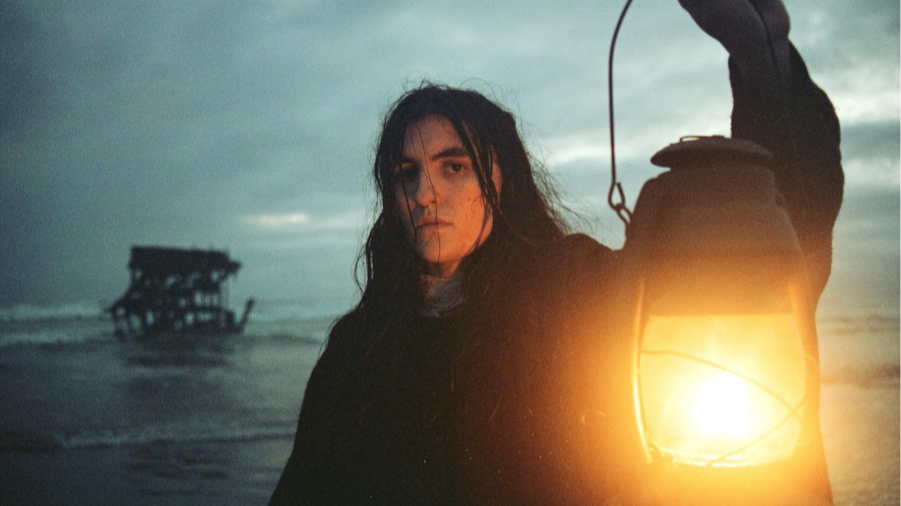
Photo: Marlowe Ostara
Portland, Oregon folk artist Searows has dropped his latest album, Death in the Business of Whaling. The album takes on a literary quality, with distinctive characters, scenes, dialogue and symbols that reach all the way through the album’s runtime to explore his experiences of fame through water, birds, and monsters.
The artist behind the album — Alec Duckart — has taken a big leap from his debut album, 2022’s Guard Dog, to create an impressively complex and hard-hitting sound while still holding onto his folk roots.
The album’s opening track, Belly of the Whale, uses these experiences of growing fame as a launch pad. With lines like, “I’ve been here for a long time / I try and I fail / I am still in the belly of the whale,” the track draws a parallel between the popular bible story of Jonah and the struggles of an up-and-coming artist. With an easy-flowing, acoustic tune mixed with the soothing ebb and flow of an upright bass, the track envelops listeners in a fantastical yet grounding world in which the whole album takes place.
Kill What You Eat follows with a more serious sound. The five-minute track gains so much emotional traction that it begins to rapidly cycle through lines, resembling a sermon. The song also contains messages presumably to people in the artist’s past: “The cost of living with yourself is enough” and “A rotten apple hasn’t always been that / I want my body back.”
The album’s third track, Photograph of a Cyclone again uses the image of something occurring in nature as a representation of a harmful period in the artist’s life. Capturing a picture of a cyclone here is remembering exact moments when the world seemed to crumble around him at the hands of another.
The next track, simply titled Hunter, places the figure of the destroyer and harmer onto the artist. With the song’s chorus, “I am a killer with a heart on fire / I’ll be the hunter when you tell me I need to be / Point at the centre, right between the eyes / Doesn’t it kill you watching somebody bleed for me?” Duckart takes the blame for hurting others just to continually be ignored.
Dirt, the album’s fifth track, uses images of wings and flying in an Icarus-esque way, using flying above others as getting the upper hand, while those left in the dirt are at rock bottom, with a standard of disappointment and envy. This image is solidified in a striking sequence at the midpoint of the track: “And all of a sudden / They’re cutting the wings from off my back / Head on the sofa / Hands in my lap / I want it back.” The second half of the track that follows is purely acoustic rambles and harmonic melody, all-encompassing and meditative; the track is an intermission between the two emotional halves of the album.
Dearly Missed, the album’s single released on October 2nd, ramps up the album’s past anger through its sound. The track features a drumbeat heavier than anywhere else on the album, actively reflecting Duckart’s line “kicking and screaming.” The song’s chorus comes from the death of one of its characters: “And just by some sort of coincidence / He drove his car off of the river bridge / They never found him and they haven’t since / He’s dearly missed,” while its music video resembles scenes from horror films, with Duckart digging the grave himself and watching the car speed away.
The album transitions into a more sentimental tone with Junie, which reminisces on a relationship that confuses and hurts as much as it comforts. With specific scenarios like “Say what I know to be true: ‘I think I’m bad for you’ / And I really meant it this time / Leaving without saying goodbye,” Duckart looks back on one of the hardest things: leaving someone behind.
Similar to other tracks on the album, Duckart transforms problems into physical beings. Here, it’s the unacknowledged problems between two people turning into a “creature that’s moving at a terrible speed” towards them.
The album’s penultimate track, In Violet, goes back to the album’s major theme by placing its characters in the middle of the ocean. Both lost at sea and in their communication to each other, two people try and fail to make “a plant grow in the dead of the ocean.”
The album’s final track is Geese. Calming down into the acoustic sounds that began the album, the track turns the listener’s attention from the water to look up to the birds flying above: “Like wild geese / Flying towards something / You do not have to do good / But you cannot do nothing.”
The water that returns throughout the album then changes and shrinks to the water in a bathtub, but still makes itself overbearing as the bathtub overflows. Subtle and poignant, the ending track leaves listeners with an open ending, wondering what will happen “when you come back.”
The continuation of images throughout the album gives it an extra layer of talent and complexity that is rare to see. Each of the album’s tracks contains its own characters, stories, and an interconnecting group of symbols that creates a whole world in which they exist together.
Duckart’s sound in this album is immersive and messy, allowing listeners to connect and lose themselves all at the same time; an ever-valuable quality that Searows can cultivate like few others.
Death in the Business of Whaling is out now via Last Recordings On Earth.