
Basht. are taking aim at what we’re told on debut album ‘Poor Advice’
Jack Leavey and Louis Christle discuss the making of ‘Poor Advice’, its personal and political themes, and writing on the road.
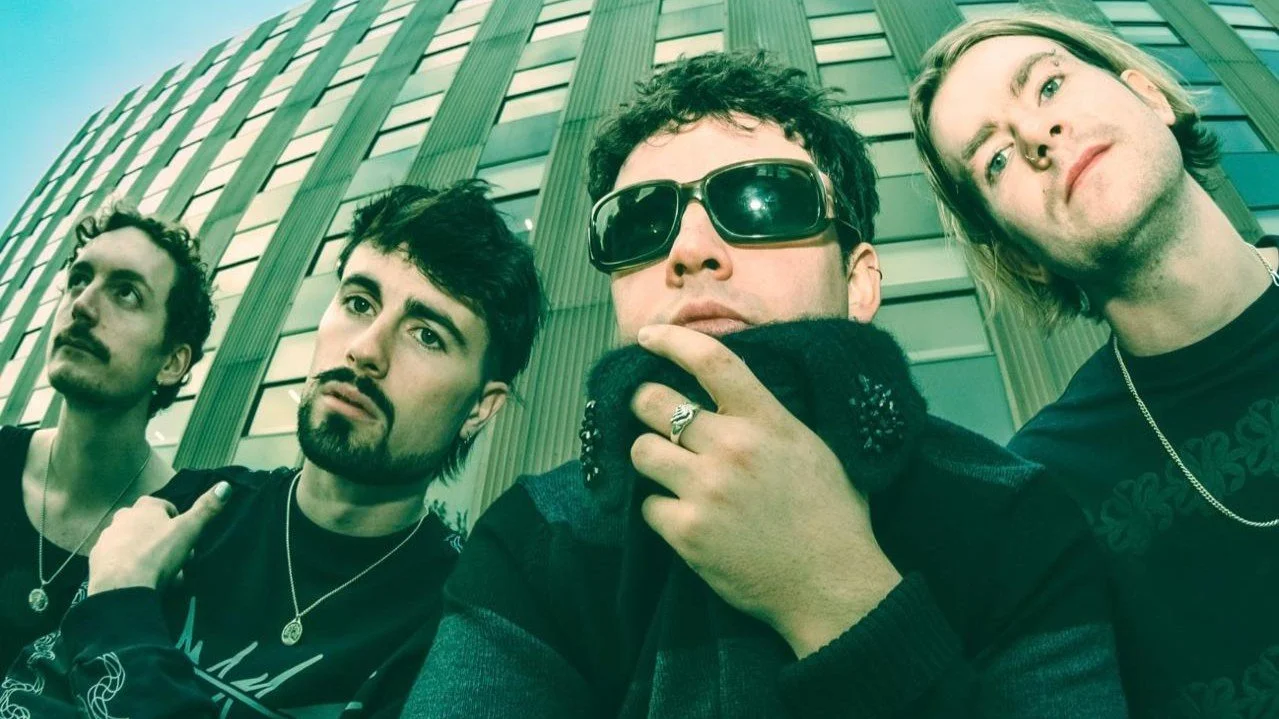
Photo: Patricia Rosingana
Rather than easing you into their gloomy, painfully honest world, Basht.’s debut album, Poor Advice, pulls you straight into its restless undercurrent. From its opening moments, there’s a sense of unease baked into its foundations; agitated guitars soar against syncopated rhythms while the darker, droning bass seems to pull the ground from beneath you. It’s like falling down a deep hole that you know you can’t scramble out of. So, you simply surrender and let it take you where it will.
Across ten songs that compel you to question, confront and move, Poor Advice’s fully fledged concept takes aim at the institutions, beliefs and ideas we inherit, as well as the impact they can have on our lives. It’s an immersive and impressive debut that doesn’t shy away from confronting the things we’re told to just accept, drawing you further into its world with each brooding track.
Yet, despite the weight of its subject matter, Poor Advice finds a compelling balance between its darker ideas and its dynamic, often unpredictable sound. There’s a constant push and pull between angular guitars and hypnotically heavy rhythms, giving the album a sense of movement even in its more sombre moments. The result is bold and intelligent post-punk that feels both immediate and pensive, ultimately showcasing Basht. at their most assured.
Ahead of the album’s release, Jack Leavey (vocals/guitar) and Louis Christle (bass) spoke to us about the making of Poor Advice, finding inspiration on the road, and the ideas that sit at the heart of their debut.
Why does Poor Advice feel like the record you needed to make now, and how far back do some of the earliest ideas go?
Jack Leavey: I think as a band we knew that the next step was an album, and I suppose we started writing about a year ago. Throughout the year, we were on tour a lot, we were kind of experiencing the world, and there were a lot of ideas born from that. I think that's probably what influenced the album, just being outside of Ireland for so much of the year. It made it a bit more of a global landscape.
Was Poor Advice always going to be a concept album, or did the connections between the songs only become clear as the record took shape?
J: I think the idea for it was there from the start, and then we were kind of fitting in the pieces into the puzzle to make the overall message of the album quite clear. So, yeah, from its early inception, it was definitely like, “This is where we want to go with it.”
What kind of musical inspirations were drawing on? Do you all have quite similar music tastes?
Louis Christle: We have a kind of overlap stylistically, or there’ll be a certain band or album that we all seem to unanimously say, “We really like this.” But I'd say as a whole, our tastes are all a little bit different, which I think was very fun and exciting when writing because we were kind of finding common ground between all of our fortes.
There were certain acts or bands that were always recurring names. We love Portishead, Massive Attack and elements of Mazzy Star. It was always a nice common ground, but then above that common ground, it was nice to put all our own DNA, flavour and interests into it. That was very exciting.
Is there any specific artist that you remember listening to while writing the album that you think had a direct influence on it?
L: Massive Attack was a big one. I felt like we were just away for so much [of the last year], especially in the process of writing the album, that I think, for me personally, I was almost listening to a new genre or artist in every city or country. So, anything from like ‘90s house or early ‘80s Detroit techno, like the organic and electronic kind of hybrid, was probably the most recurring inspiration for me.
MJ Lenderman’s Manning Fireworks as well. I listened that front to back hundreds of times on that tour. On the topic of Catholic church and that role, and childhood into adulthood [that album] was also very big.
One of the interesting things about the album is this tension between the personal and the political – relationships, families and individual experiences set against the much larger forces of the church, the state, war and corporate power. What made you want to explore such big ideas through individual stories?
J: I think we just found that there were a lot of comparisons to draw between one-on-one personal relationships, and then the relationships people have with authorities and higher voices. Seeing where that stems from and how it can affect you on a very personal level while it's quite a global issue.
How much of the record comes from things you've personally experienced, and how much is your perception of the outside world?
J: I think there's a very thin veil between the two of them on this album. Personal influences are always going to be there, but I think we try to compare them or mix them in with perspectives on how we feel about other issues, and try to weave them all together, so that it’s not exactly like this song’s about this thing. There are a few different layers to each of the songs.
What song on the album do you think best represents its philosophical core — the one that, if someone understood that song, they’d understand what Poor Advice is really about?
J: I think probably Superchurch, maybe. Or Poor Advice. Superchurch probably more for me. In Ireland, for the most part, people get brought up under the Catholic church, and then that song is all about getting out of that and walking away from it. It's like you might not understand why I'm walking away, but that's not for you to understand, it's for me to do for myself.
While you stick to your post-punk roots on the album, there’s an especially interesting contrast in Terror TV. Musically, it feels incredibly free and almost carefree, yet lyrically it’s about exhaustion, violence and becoming numb to a constant stream of bad news. Was that tension between the music and the subject matter deliberate?
J: Yeah, I think the whole idea of that song is the juxtaposition between what we're told, what we see, and the reality of it. So, what you see on your TV versus you just being numb to it. But then the feeling of the song is like, “just shut up and have fun.” The lyrics bring you back down, and it’s like, “No, this is all part of this illusion that we're living through.”
L: And I think because a lot of the album felt sonically dark, I thought it was kind of fun and interesting to make one of the most lyrically dark songs, the most major and upbeat.
You’ve spent the past year touring across the UK and Europe and playing your first US shows. What have you learned about yourselves as a band from being the on the road so much, and has that experience informed the music you’re making now?
L: Because we actually did write a lot of this while we were away, I think what I learned is that we're very good with what at first seems like pressure, like if you feel a need to write while you're away. But it didn't feel like pressure at all. It actually felt very natural to me, so that's one thing I realised we were pretty good at, just writing on the fly and taking influence and inspiration from wherever we are.
It seems like quite an intense process to me, doing all that touring and then still finding time to be creative within that. Have you guys always been on the go?
L: I'd say we always were without realising it. Probably only this year, it became very evident, and we were like, “Oh, we can write with loads of downtime and no pressure, or we can do it with a week off in the middle of the tour.” So, it's good to know that we can adapt to it.
Do you think about the live show when you're writing at all?
J: You do, yeah. Songs like Circadia, we just knew would go down well live. You try not to let the lyrics be affected by that, but I think, sonically, it's pretty fun to write a song with the intention of making people move.
The album artwork is quite striking as well. The black and white image and the contrast between the child, a traditionally innocent figure, shooting at something. What’s the story behind that image?
J: We kind of knew that we wanted the single artwork to be stained-glass pieces with some cracks in it. The symbols representing the ideas behind the songs. Then we thought it was perfect to have the child – Harley – be shooting at something. It's like he's the kid shooting at the establishment, shooting at the stained-glass that you might find in a church. He's taking shots at what he perceives to be the authority in his life, and he's questioning what he's been told from an early age.
Ultimately, when people listen to the record, do you hope that they might question some of the things they’ve been told in their own lives, or are you just hoping they’ll enjoy it?
J: I think we're hoping people will enjoy it. We wanted it to be a fair representation of the band for where we are now, and we want people to think about things in a slightly different way, or l maybe just question some of the things that they're told. And I think that'll be enough for us.
Poor Advice is out October 9th via LAB Records.