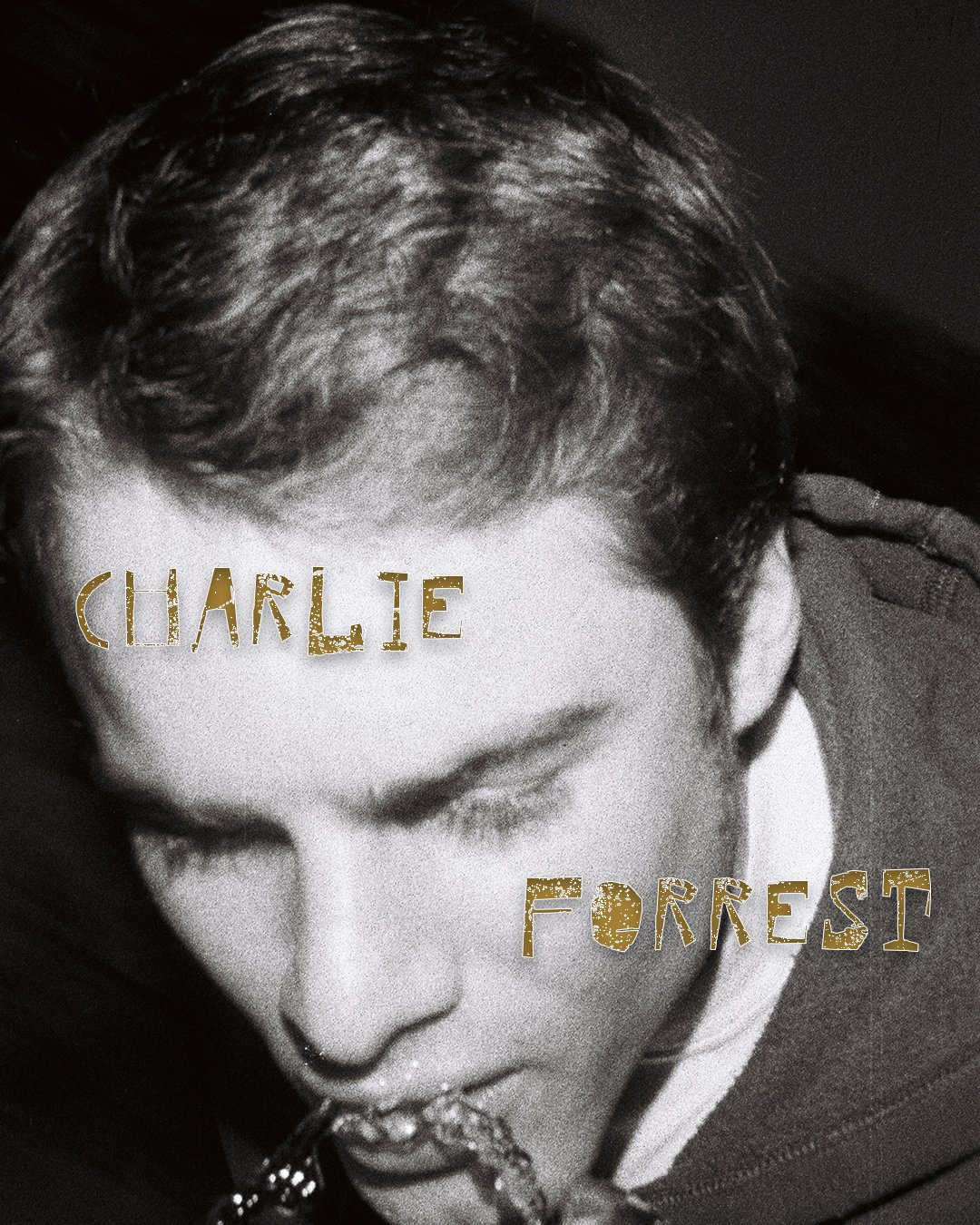
Charlie Forrest: The folk musician who caught The Clash’s ear — and records everything on a laptop
His music sounds borrowed from another era. His setup would make most producers wince. Charlie Forrest has never sounded more like himself.

Photo: Lewis Recordings
It’s about halfway through our conversation when Charlie Forrest turns his laptop screen around to show me how it’s made. GarageBand. A microphone to one side, a few guitars just within reach, the rest of it — the warmth, the layered harmonies, the feeling of music borrowed from another decade — all of it happening on a screen that looks like it could belong to anyone.
“That’s basically it,” he says. “I just do everything through that.”
It takes a moment to sit with. His music — somewhere between traditional English folk and early American lo-fi, Nick Drake and John Martyn on one side, Buddy Holly and The Everly Brothers on the other — doesn’t sound like it came from a laptop. It sounds worn and warm and slightly out of time, the vocals sitting back from where you’d expect them, unhurried, like a voice carrying across a valley rather than aimed directly at you.
“I honestly just fiddle around,” he continues. “I’d love to record with a really expensive microphone, obviously… but I don’t have that.” He says it without any particular longing.
“The limitations kind of build the sound,” he says. “If you had everything, there’d be too many options. You can spend all day wishing you had more, had different things around you, but you’ve got to accept what you do have. What you have at your disposal.”
Forrest is 27, raised in the rural Southwest of England, currently based in Stoke Newington, where he ran a grassroots folk night called Wagtail for a while — the kind of small, unhyped thing that tends to matter more than it looks like it’s going to. It was there that Paul Simonon of The Clash first came across him, which led to a support slot at a sold-out Bush Hall and the attention of Lewis Recordings not long after. His debut EP, Moon is Bright, picked up support across BBC Radio 6 Music – Guy Garvey, Marc Riley, Craig Charles among those playing it – which, for music this quiet and this particular, says everything.
He tells me all of this a little shyly. This is, he admits, his first proper interview. Though he’s not nervous, just not entirely sure how to talk about the reasons behind the music, having never really had to before.
Golden Wisdom is his new EP, and it begins, as a lot of his thinking seems to, with something stumbled upon in a record collection. The lead single As The Waves Crash In came from a Numero Group compilation called Eccentric Soul: The Way Out Label – forgotten soul tracks from the ‘50s and ‘60s, music made carefully by people who meant every word of it, in rooms that cost very little and sounded, somehow, enormous.
“It heavily influenced me,” he says. “It’s derived from a lot of that ‘50s and ‘60s soul.”
You can hear it in the grain of the record. The sound of something worn in rather than polished, something that has been lived with. Love arriving like a flood without warning, knocking you down and leaving you on the floor to pick up what you can.
The countryside he grew up in has a way of finding itself into the writing too – without announcement, the way formative things tend to. A particular tree, a hill he knows the shape of or the view from a bedroom window that’s become its own kind of internal landscape.
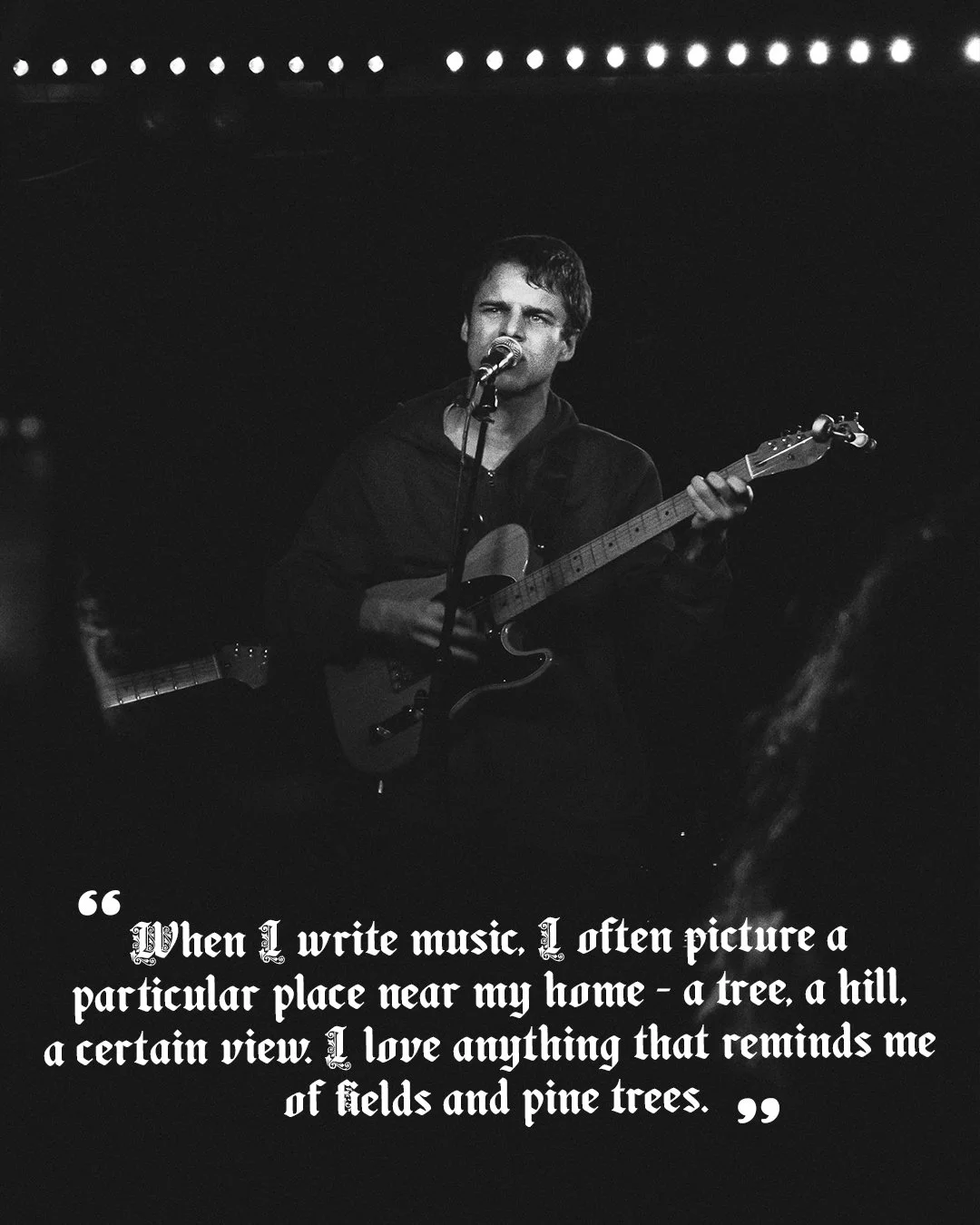
“I think a lot of it is looking back to when I was younger,” he says. “Finding comfort in the natural surroundings. It kind of gives context to your isolation. When I write music, I often picture a particular place near my home – a tree, a hill, a certain view. I love anything that reminds me of fields and pine trees.”
For Now I Know, the EP’s second single, came from somewhere warmer and altogether more expansive.
“That song came quite naturally,” he says. “I was thinking of Buddy Holly — his songwriting is very simple, very stripped back, just three or four chords. I wanted to create a big band sound from gospel tracks. Working with a basic setup, I tried to elevate it with backing vocals and harmonies to capture that euphoric feel.”
The harmonies fold low and high into each other, blending rather than separating, giving the track something almost choral underneath its warmth. The lyrics stay small and precise — sunlight falling through a window, a river moving past fingertips, a soft reassurance dressed up as certainty, please don’t weep, the sky over there is clear — and the smallness of them is what makes them land.
“I like lyrics that put something in your head,” he says. “Something you can actually see.”
He reads a lot – Mary Oliver, mostly, and Emerson, whose work Oliver herself called a lifelong influence — and you hear it in the way the songs are built, each one finding its shape around a single line that came first and refused to let go.
“A phrase will catch,” he says, “and then I build the rest around that. Usually, it’s just me sat with the guitar, nothing around me, just playing and singing — and that’s when it comes easiest.”
He tried writing poetry himself for a while, laughing at the memory of it. “Pretty bad poetry,” he says, before moving on with the easy air of someone who has long since made peace with a closed chapter. “I would describe myself as a songwriter first. Before anything else.”
There are apparently unfinished songs all over the place — melodies he loves that words that never arrived for, sitting on a hard drive somewhere in no particular hurry.
“There are loads of them,” he says, almost cheerfully. “Melodies I really like, but nothing quite fits. You just have to leave them. Maybe move on.”
He talks about the Beatles, Sgt. Pepper’s specifically - albums that run as one coherent thing from first track to last, almost like a story unfolding – and there’s something in the way he says it that feels less like a quiet ambition, something he’s working towards rather than something he’s arrived at.
“I love albums that have a thread running through them,” he says. “That kind of runs from the first track to the last and has almost like a story. I think that’s amazing to do.” A pause. “Maybe that’s something I could build towards one day.”
The artwork came from his friend Harry Yates, a graphic designer who worked on Moon is Bright, too. They grew up sharing music, and the shorthand has been there ever since.
“He just sent it to me,” Forrest says. “And it worked.”
Near the end, I ask what drives all of it, what sits underneath the songs and the old compilations and the late evenings on GarageBand and the half-finished melodies waiting for words that might never come. He doesn’t have to think about it for very long.
“I just love listening to music,” he says. “It’s not that different from finding a song you love and playing it every day. I just want to try and make something like that.”
His music isn’t upbeat, he’s said before, but it comes from a positive place. Spending an afternoon with Golden Wisdom, drifting in and out of it, that feels exactly right — patient and specific and quietly certain of itself. A golden afternoon light through cotton-white curtains. A brook running somewhere at the bottom of a valley under a willow tree. An old record that got under his skin years ago and never quite left.
Golden Wisdom is out now on Lewis Recordings.
You can also find this interview in print. Pre-order Issue 2 of The Indie Scene Magazine here.