“We thought we were a one album band!”: Green Lung talk upcoming album ‘Necropolitan’
Ahead of the album’s release next month, the band talk comic book influences, their first ‘collaboration’ with Castle Rat and why vinyl matters.
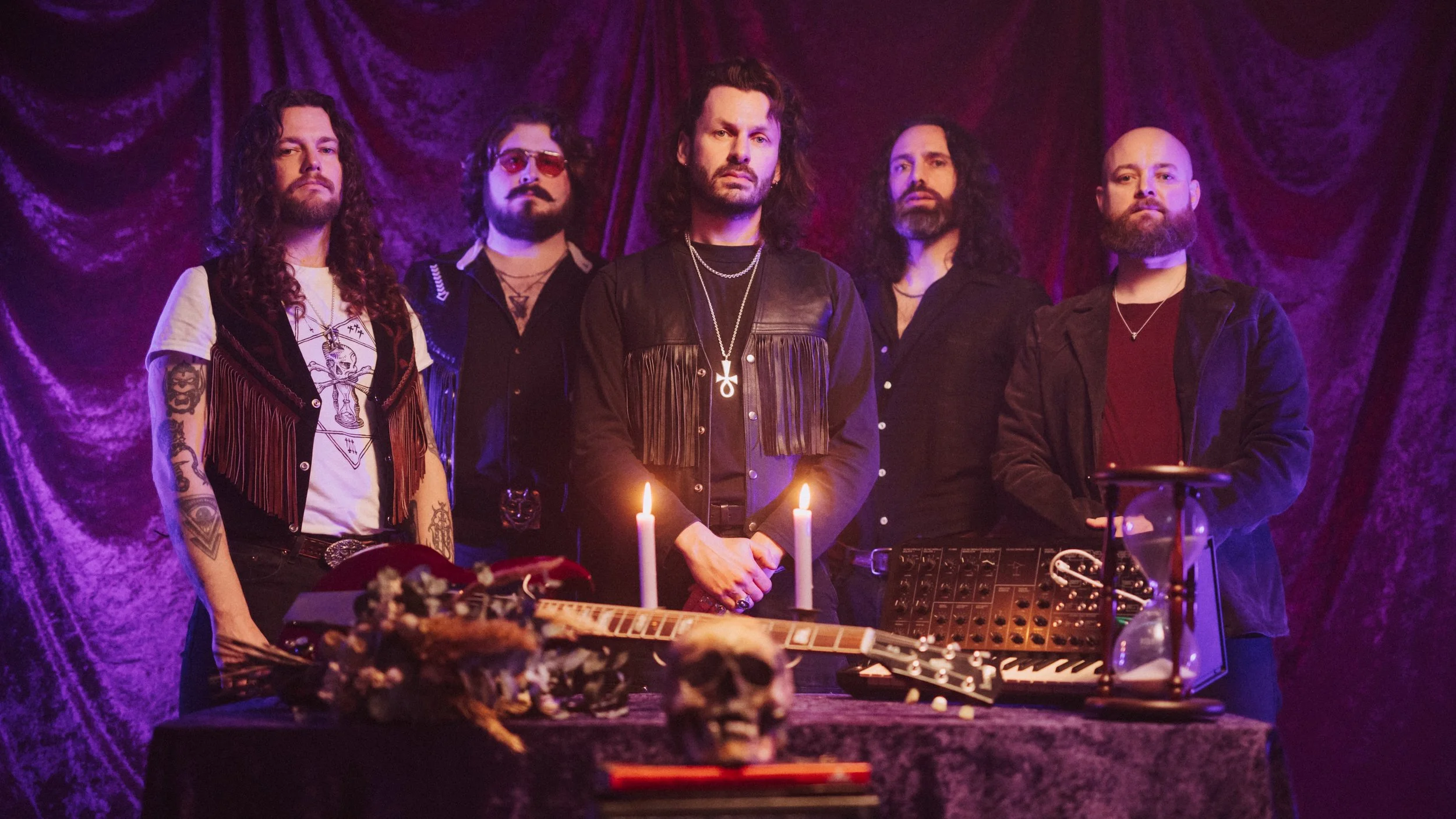
Photo: Andy Ford
In 2016, during London festival Desertfest, three mysterious figures met at the Black Heart pub in Camden. There, they conspired, plotted, schemed. When they left, they were the founding members of a new occult metal band, Green Lung. Three years later, the group – now renowned for their songs about British folklore and cult horror inspired settings – put out their debut LP, Woodland Rites. It became an instant classic in the doom metal and occult rock subgenres, perhaps best immortalised in the album’s enduring staple, Let the Devil In.
In the years since, Green Lung have released two more albums (2020’s Black Harvest and This Heathen Land which came out in 2023) and delivered sets at Bloodstock and Download. Now, they’re back with their fourth witchy offering, Necropolitan. The album deals with themes of death, spiritualism and human greed, while plunging into familiar-but-fresh historical set pieces and legends. For example, the five-piece explore London’s Victorian Necropolis Railway, Aleister Crowley and the work of Percy Shelley.
We asked vocalist Tom Templar and guitarist Scott Black about this new era for the band; how the album was born, what influenced its unholy hymns and what Necropolitan is all about.
Your new album, Necropolitan, is out September 11th. What’s it about?
Tom Templar:It’s kind of a love letter to London, the city that led to Green Lung. We all grew up in various parts of the UK. I was in Norfolk, Scott was in Kent. We all met in London, around the London metal scene. The band’s gonna be a decade old next year, and it felt like time to bring the Green Lung ‘lens’ to London. I felt like I could write about it having spent 15-odd years here, in a way that I couldn’t when we started the band. I still felt fresh off the boat then.
You want to pay something back to the scene around you. We played Desertfest [London] in May, and did this big headliner. That was kind of going full circle. Scott, Matt [Wiseman] and our original bassist, Andrew [Cave], had literally started the band at Desertfest. So I felt we needed to do this album. We’d also done a little bit on London on the second record, with Graveyard Sun. People seemed to really respond to the world building element of This Heathen Land. That just kind of emboldened me to take that further, and London felt like an amazing canvas for that. And like, it’s been done in such cliche ways. You know, it’s Jack the Ripper. There’s so much more to it, and I felt like I wanted to explore that. Do it our way.
The title track, Necropolitan Line, deals with the real life Necropolis Railway. Have you wanted to write about that subject for a while?
Tom: Definitely! I don’t know when I started wanting to do a song about the Necropolis Railway. Probably some way back. And then Scott came with this song which was so locomotive-y? It’s the kind of riff you’d normally write a car song around. With Green Lung, maybe horseback riding is the closest we get! And the Necropolis Railway was the perfect thing to do.
Scott Black: I remember you telling me about the Railway, and being like “I think I’ve got just the thing…”
Tom: It’s often like that for us. The lyrics and art and the music are really separate. Scott literally writes a completely fully-fledged demo, and meanwhile I’ve been working away on this storyline. It’s funny how often that happens, that they just sort of click. Doesn’t always happen. But that one worked. That one could only be a song about the Necropolis Railway.
Your songs explore very specific, sometimes obscure bits of history or folklore. Do you spend your time going down these rabbit holes for the sake of the music, or out of interest?
Tom: It’s a bit of both, I think. There’s a big notebook of interesting stuff that’s come into my path. Before Green Lung, I was still doing this, but I wasn’t thinking “that’s for Green Lung”. I was just into the gothic and the weird, and I want to read up about it and watch every movie and explore everything. I’ll know if something fits. Some ghost stories I’ll read or horror films I’ll watch are a million miles away from Green Lung. I think with this album, maybe more than others, we’d discussed the central concept quite early on, so stuff would just fall into that general thing more.
Scott would send me this massive, shaking, Rainbow type riff, and I feel like there’s a Maiden-y thing there. I saw Maiden play at the O2 last year. They played Alexander the Great for the first time in ages. I wanted to write something that was like the inverse of that, where it has the feeling of a song about a big, legendary figure, but it’s actually ringing hollow and dooming, because that figure is a statue in the desert that everybody’s forgotten about, you know?
It’s more like I do the reading I would always do, except now there’s this flash and it’s like, oh this is a Green Lung song. I think Steve Harris is a good example of someone who likes to bring literature into metal. I wish it happened more. That’s part of why we love doing Green Lung. For Scott and me, it’s doing the band we want to listen to. It keeps you not second guessing what’s going on. It’s kind of about not giving a fuck and doggedly doing the thing we want to do.
And obviously you have to try and fit it into the modern music industry, which sometimes is a bit of a faff. But I think the songs are ultimately why people care. It might seem to someone, like why are you bothering reading two books on Crowley to write a four minute song? But for me, I’m loving that. It’s fun. It’s a twin thing. The research and making the art are both pleasurable in different ways. It’s not a job. [Laughs].
Are there other characters or events you want to write about?
Tom: Yeah, definitely. Early on in the band I would just have a list. When I was writing Woodland Rites, it was a notebook of like, ‘May Queen folklore is interesting’, or the book Into the Wild by Jon Krakauer. The longer you do it, you get more ambitious. You end up having a fuckton of things you want to explore. You subdivide them into what will hopefully become different albums.
I think that’s a process I’ve been on since This Heathen Land. It’s probably quite annoying if you’re Scott, because he might have just written an album of great tunes, and I’m already there hammering at the door, being like, “I’ve worked this out in way too much detail and I already know what the art concept is.”
It’s almost reassuring when you come to the end of a project like Necropolitan, that involves a lot of work, and immediately feel like I wanna get back on the horse. I remember us talking during Woodland Rites that we’d be a ‘one album and done kind of band’! It’s not how it’s shaped out. I feel more excited about Green Lung now than I did ten years ago, because we know we can do it. We’re a lot more confident as a band.
What are your other biggest influences?
Tom: From a lyrics and art point of view, I’d say Alan Moore is a big influence. That whole era of comics, film, whatever, where it was a bit more reaching into the canon of folklore, history, and bringing it together. A good example from him is The League of Extraordinary Gentlemen, this team of superheroes constructed from Jules Verne, Dracula, all these different places.
Mike Mignola, who did ‘Hellboy’, too. He’s a good example of like, it might not be obvious, but I’m definitely inspired by them. Incredibly well researched, deep knowledge of folklore, beautiful style, and having this sort of world that is at once familiar, but turned on its head. Steve Harris is a big influence. Early on, I was really influenced by bands like Orchid, Electric Wizard, Blood Ceremony — the bands that were reviving ‘70s heavy rock when I was seventeen to twenty.
Scott: All the obvious cornerstones; Sabbath, Queen, Uriah Heep, Deep Purple, Rainbow. That era of metal before metal figured out what it was? It was a lot more malleable, a lot more liquid back then. A lot of metal can feel so atomized into different genres now. It was taking that kind of sound, that vibe, and marrying it with more intentional songwriting. Like, what if Uriah Heep tried to write a headbanging chorus?
I find a lot of inspiration in other genre bands that start from quite a restrictive platform and then grow into something else, in the same way Green Lung has. We started off very much indebted to those bands Tom mentioned, and over the course of the last ten years, they’ve become something a lot more in and of itself. I think a band like Turnstile would be a really good example. As they grew – while remaining themselves – they became something a little different in a way that felt very natural. I appreciate bands that can grow from that restrictive genre base to something more themselves.
It’s been a couple of years since This Heathen Land. When did you start work on Necropolitan?
Scott: Probably whilst we were on the Unto Others tour [both bands co-headlined the Heathen Neverland Tour], which would have been February 2025 — I’m just looking at the gig poster, because I can never remember when anything is. I think on that tour we were doing a lot of the thinking and conceptual chatting about what [Necropolitan] was gonna be, thematically and musically. We always like to have a bit of an idea of what the album wants to be. We want each album, whilst feeling coherent, to have slightly different identities.
Tom: I really remember Scott sending us what became Evil in this House. We were flying out to Greece. It’s always the way that you have a few early songs and you know exactly where they’re going. The way Scott writes, he’ll write two or three songs, and then work out the rest of the album from there. For example, Together in Death was a late one, because we felt we always have that dynamic track that’s been a staple, like Oceans of Time, May Queen, Graveyard Sun. Each album has a song that’s a bit more light and dark.
It's funny, it’s definitely an organic process with us. The more we tour, the more we talk about it. We didn’t always have that option, with day jobs and stuff. When you actually have a month-long tour, you can hang out and work on it together.
Dance to the Grave is perhaps a little more political than your other tracks, about the rise of dependent technology and climate change — similar to Black Harvest’s Born to a Dying World. Do you think it’s important to address these very real issues in your music?
Tom: It’s weird. You mention Born to a Dying World. I had a really surreal moment where Dunwich Heath, where that song is set – part of Suffolk where the coast has eroded into the sea and you can hear the bells of the old church underneath the water – that’s where there’s currently this giant wildfire. It’s really eerie. The song is literally about a wildfire and a tide kind of thing.
There’s never a moment where you go, “this one is gonna be political.” It just happens organically. In This Heathen Land, Hunters in the Sky got a bit spiky about the right to roam, or you could argue Maxine (Witch Queen) is a feminist retelling of a popular witchy couple. But you don’t want to beat people over the head with a political stance. My favourite bands, like Sabbath, or Maiden, can write about traumatic events or dark history and leave it to the listener to decide.
Dance to the Grave is about as preachy as I get, other than Leaders of the Blind. Those two songs in my head are similar. They’re angry. Dance to the Grave was written after the Californian wildfires. I saw this image of people playing golf with the wildfire raging behind them. That’s Dance to the Grave. You have your political beliefs and sometimes they rear their head and sometimes they don’t. It’s weird in metal, like War Pigs for example is an extremely political song, but it doesn’t land the same as Joan Baez.
The track Alostrael (Be My Babalon) sees you collaborating with the incredible Riley Pinkerton of Castle Rat. How did that happen?
Tom: I’d written a song about Leah Hirsig, who was Crowley’s kind of American muse. I really wanted some narration from Revelation on the album. We talked about a few narrators we could get, and they were all men. I thought, do we know any American women who could play the part? We’d literally just been on tour with Castle Rat in the States.
We love those guys. We spent nine days with them; their first proper tour of the States was supporting us in 2024. They’d come such a long way. I saw them in LA a month ago, at the House of Blues. It was sold out. So good to see. They’re doing a similar thing to us, I think, but in a much more Frank Frazetta, America way. Whereas we’re much more the witchy English way. [Laughs]. That’s the first time we’ve had someone else on a track. Lot of fun to do that.
How does Necropolitan compare to your previous three albums? Where does it fit in the Green Lung canon?
Scott: I think its focus, more than anything. Focus and more of an emphasis on riffs. With this record, we wanted to do something that felt a lot more natural and live. In the studio, we’re quite maximalist, we have very dense arrangements, lots of different instruments, sounds; very rich and cinematic. We wanted to strip all that back and do something that’s just these five guys in a room.
I think we’ve built something of a reputation as a live band. We have no end of people coming to us and saying, “You resonate with me so much more live than in the studio.” We wanted to do a record that tries to capture that. We wrote and arranged everything for [playing] live, for those five guys in a room. The necessity of doing that is that it changes what you write.
A simple, very ornate song, like Forest Church for example – once you strip back all those layers of vocals and keyboards and myriad guitars – something that simple wouldn’t work, if it's just one guitar, and one organ and two vocals. It was stretching ourselves musically in a way we hadn’t before, which made us rely much more on the immediacy of riffs and musicality. It’s a lot more technical and mechanically complicated in terms of what we’re doing. Compositionally, a lot more proggy in that classic ‘70s way than This Heathen Land. I see it as a grand unifier, kind of taking everything that we’d done in the past three albums and making it an amalgam.
Tom: You always want to challenge yourself. You don’t want to feel comfortable. And doing it essentially live in nine days after having had a whole month for Heathen Land was just that. All the best stuff happens when you’re really up against it. It was pretty harmonious, but it was also like: wake up, get in the studio, work all day, clock off, go to sleep, get up again. We had to bring our A game. In a weird way, I kind of see where Greg Ginn’s coming from now. [Laughs].
The longer you go, you have to give yourself parameters. A lot of the ills from the current music scene come from being able to do anything. AI’s never going to help that; there’s infinite possibilities. But forcing yourself within some limitations is such a powerful thing. A lot of my favourite albums were recorded in a couple of days. You can’t fake that energy.
You guys are touring the UK and Europe in December, with High on Fire and Gnome. Have you given any thought as to which tracks from the new album are going out on the road?
Tom: I want to do all of them. [Laughs]. Necropolitan Line for me, Ozymandias I really want to do, and I really like To the Gallows Born because it’s about being onstage. I think it’s going to hit different live. Those three for me.
Scott: Same three for me as well. Dance to the Grave, actually. I think that big riff is going to be such a good ‘chucking a grenade in the pit’ moment. I can’t wait to drop that one.
Tom: That’s going to be a big one. I just think that riff in the middle of Ozymandias, [starts mouthing the solo]. It’s funny because you have to pick the singles, and I feel like we’re so not a singles band. There was a time when Led Zeppelin could just put out albums and never release a single. But unfortunately, that’s not the case now.
For me, the heart of the album is Ozymandias in a way. But it’s exciting, because people hear little bits and then get the whole thing. I don’t like listening to singles before the album really. I want to hear the whole thing complete. It‘s a weird process.
How much say do you have over the design of the album — the artwork, packaging, vinyl colours, etc.?
Tom: We literally do eeeverything. I think labels do make certain bands, and do their art and stuff, but I think because we were DIY from the start – like, we self-financed Woodland Rites – we always had total control. For me, there’s no divide. I couldn’t imagine someone else doing the vinyl package. It wouldn’t be Green Lung. It’s gotta come from us, even down to the colour of the vinyl, and picking those out from a chart. Sometimes our manager is like “I really want this one” and we go, okay, fine.
The art and effort that goes into the physical copies of your album is insane! Do you feel physical media deserves a little extra, like lyric booklets or art prints?
Tom: To me, the vinyl package is the full thing. If you’re listening to it digitally, you’re getting a bit of it, but you’re not getting the full thing. It’s so empowering, I think, having the vinyl be the master copy almost; it reduces the power of the tech companies that are bleeding artists dry.
Spotify is another format, it’s useful if I’m walking around or in my car, but I’m only getting a thumbnail. I don’t really feel like I’ve ‘met’ the album until I’ve seen it [physically]. For me, that’s a really big part of it, and it always will be. In an age of AI, no one can replicate it, you know? I will always annoy the hell out of the label with it.
Necropolitan is out September 11th and can be pre-ordered here.