The popstar spoke to us about her album, tour and being an independent artist.
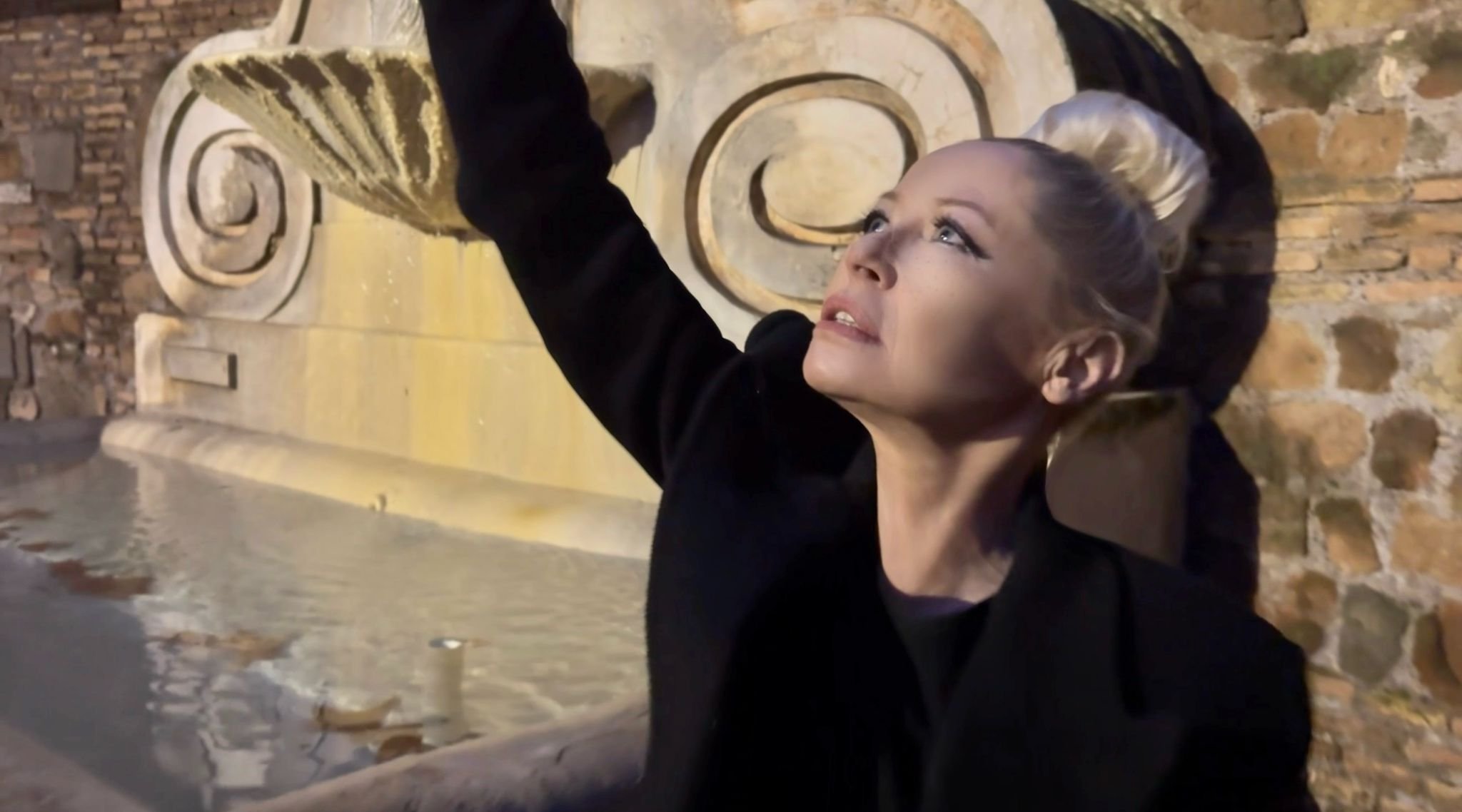
Photo: David Leigh Dodd
The blonde-haired popstar behind hits Baby I Don’t Care and I Want Your Love talks about her latest album, The Shape of History, her upcoming tour and life as an independent artist — with a little Vampiric mayhem for good measure.
It’s half-past-one on an atypically warm Monday afternoon when I sit down for the interview. I’ve taken the latter half of the day off work, and I feel like a big kid bunking off school. Except instead of sneaking off for a gig I’m a little too young for, I’m interviewing Wendy James, the image of punky 80s powerhouse Transvision Vamp, about her upcoming tour, her latest solo album, and life as a truly independent artist.
I’m nervous. More nervous than usual for these sorts of things. I’m always at least a little anxious — it comes with being a writer, we prefer the company of books and semi-colons to people and awkward video call pauses — but this time is different. At my feet are vinyl copies of Pop Art and Velveteen, Transvision Vamp’s first two albums. They were made before I was born, part of someone else’s record collection way before my own, and their grooves contain some of my favourite pop-rock tracks of the era. They capture a moment so impossibly distant for me, so untouchable, and Wendy James — the legendary frontwoman of that outfit — is the epitome of that. So yes, my brow is a little sweaty, and I’m testing my microphone a dozen times to keep the technical glitch awkwardness to a minimum.
Obviously, I needn’t have worried at all. The first thing that struck me of Wendy was just how patient she was, persevering through my befuddled hello and declaration of love for all her years with the Vamp. She listened intently, thanked me when socially acceptable, and seemed genuinely happy to answer my questions.
The second thing that struck me was Wendy’s transparency. Questions about how albums are made today compared to the early 2000s veer off into age-old horror stories of predatory and ‘carnivorous’ A&R men. “It’s the music business, it’s not ‘the music friendship’… And you shouldn’t be under any illusion that it’s any way other than that,” she explains. It’s a refreshing perspective from a now genuinely independent artist, one who’s tasted both mainstream success with Transvision Vamp, scoring number one albums and countless magazine covers, and one who’s got used to booking her own gigs and answering her own e-mails.
Of course, the reason for our meeting in the first place was to discuss Wendy’s latest album, The Shape of History, which came out in October 2024, and the upcoming tour to celebrate its release.
This October, you’re going on tour all over the UK. How are you feeling about it?
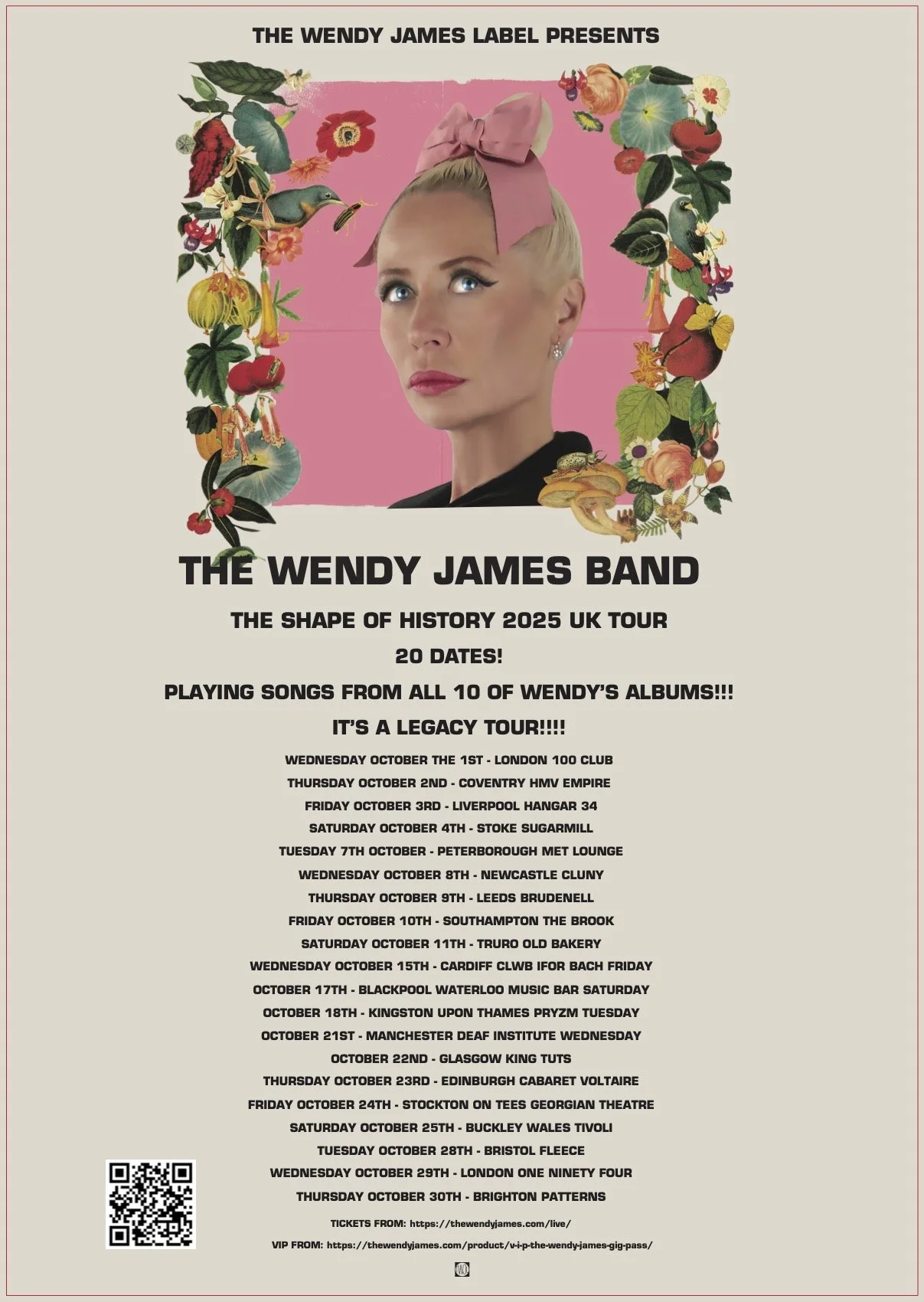
“Well, it’s a bit crazy at the moment,” Wendy explains, “because I’ve added on some Australian dates as well. I really manage everything myself. I am my own record label; I don’t have a manager. I just have good friends that I bounce stuff off. So, at the moment, my heart sinks — although I am so grateful — that every morning there are 20 emails to plough through before you can even get back to zero and start work on what you need to do.”
But for Wendy, the feeling above all else is gratitude for her fans, “I’m certainly not complaining… It’s pretty amazing that after these years, since Transvision Vamp broke out in the late 80s, to still be putting out music!” James has put out seven albums since Transvision Vamp broke up in 1992, under both her own name and as frontwoman for the group Racine. The Shape of History, released last year, marks James’ tenth as lead vocalist. “I’m so proud of my music now, I really think I’ve proved myself, to me and to the music world, to music buyers and fans. But, the fact I’m still gigging around and people want to see me, and not just that, but they seem to think it’s a good show, that gives me great pleasure.”
James also holds a clear love for her fellow bandmates, taking every opportunity to sing their praises as musicians in their own right. “It’s taken me quite a few years post-Transvision Vamp to surround myself with musicians I absolutely love, admire, rely on and trust. I have a good team that are loyal, who I love to bits, who deliver such good shows. I’m in a good place.” James’ current band includes fellow Vamp Dave Parsons (bass) and James Sclavunos (drums) of Nick Cave and the Bad Seeds. Previous collaborations include Iggy & the Stooges’ James Williamson, Glen Matlock (Sex Pistols) and Lenny Kaye of the Patti Smith group, all of whom appeared on James’ 2016 album, The Price of the Ticket.
This is your tenth album and you’ll be performing stuff from across all ten. How do you go about collating a setlist?
Without a moment’s pause, James smiles, “I’m resigned to the fact that my August is not a holiday. In my head, at the beginning of this year, I thought, ‘I’ll just take the summer months really easily’. But, on August 1st, I’ll start learning the set. But that’s doable for me, because I’m a quick study, and I wrote these songs and played them in one iteration or another.”
James spares a thought for her fellow musicians. “The people I feel sorry for are the band! Back in April, I sent them all a two-hour setlist that they had to learn. We’re not playing [for] two hours, but we need alternative songs.” She looks down at her phone for a moment, scrolling through an inundated inbox for one from April of this year. “27 songs, [laughs]. Usually, a band has to learn fifteen max, and the worst is yet to come. When we go over to Australia, which is far more Transvision Vamp-led, they’ll have to learn five more Vamp songs.” James recently announced a string of Australian shows for March 2026 under the TV name, 27 years after their last headlining tour there. “But, again, one reason we all work together so well is because they are fairly perfectionist and obsessive, too. They’re doing little rehearsals by themselves in London, getting together and doing their homework. Because ten albums is a lot of songs. Even if you pick only two songs off each album, that’s still 20 you’ve got to do. It’s a lot.”
How many can we expect from the new album?
“For the UK, it’s far more The Shape of History, because my fans know and really enjoy this album. So we’ll be playing the lion’s share of The Shape of History, and then on different nights, different songs. Whereas the Australia shows will have a lot more of the Transvision Vamp numbers, with a good selection of my solo albums. Whichever way you cut it, it’s a lot of work.”
What do you love most about touring?
“The simple answer is singing,” says Wendy, “I really love singing. This was brought home to me last year, when The Shape of History came out. Alex [Ward], my main guitarist, and I went off and did a lot of instore shows for the album, which was just the two of us playing, quite low decibel, in record stores. Usually when I’m out with my band, they’re fucking loud.” It’s one of the few times James curses during our half hour together; there’s not so much of the outrageous hair and leather jacketed sneer in 2025. Instead, James - effortlessly well-spoken and well-mannered - saves that inner rebel for her albums, which often feature bite-sized, punky rockers and snarling, barking choruses.
“With those record stores, it was just him playing a little tender piano or gentle guitar, and I could really hear my singing. I luxuriated in it. It was so nice to just hear myself, the same way I hear myself in the studio. The answer really is the music.
Once I’m up on stage, I want to deliver for myself and the audience. And, I know it’s crazy, but I do meet and greet beforehand [VIPs who pay extra for a range of pre-show perks] and afterwards. Everyone gets the chance to come meet me at the merch stand, buy something, sign something, say hello, get a picture. That adds on another hour and a half to the schedule. Get there for soundcheck mid-afternoon, then meet my VIPs, then the gig, then the free-for-all for everyone. You get home at midnight.” For a moment, James admits the fatigue of such a physically demanding role. “When you close the door to your travelodge room, it’s just like, [exhales]. Then you wake up in the morning and go again.”
But for Wendy, it keeps coming back to that universal constant of the music and what it means to her fans, "the pleasure is the gig, and meeting everyone. It restores all your faith in humanity. The most unlikely people - a bricklayer in Southampton - comes along and describes what a particular ballad from 2002 meant to him. You’d be a fool to think one person is defined by one thing. Because all these people, they know lyrics that really connected to them. It’s the music and the humanity of the whole thing.”
You’re playing Australia next year, with Transvision Vamp. What made you want to tour there?
“I wanted to go back to Australia, because - with the exception of the UK - Australia was our biggest success, all those years ago.” Pop Art and Velveteen became platinum-selling albums down under, with the latter reaching no. 2. “And I just have great memories of it being nuts. Doing incredible shows, but having such a laugh, and being in our element over there.”
“It was really un-premeditated,” Wendy explains, offering an insight into how she essentially manages herself, “What I do, which is useful advice to any of your audience who don’t have a manager or an agent, is - in maybe February - I looked to see where comparative bands were playing in Australia. I could see the basic venues that were cropping up repeatedly. I made a shortlist. I wrote to each of them. A couple of the venues recommended ‘talk to this promoter, it would be far better for him or her to organise your whole tour.’ Because Australia really isn’t Europe. It’s different tax, it’s different card readers for merch, you don’t know your way around Australian cities like an Australian tour manager would. I can tour manage us in London - it’s the Central line, be there at 3! But it’s not the same in Melbourne. I don’t know the first thing.
So, I spoke to these promoters, and they were both really lovely. I went with one, and he said, ‘Listen, basic truth here is that the Wendy James band and your solo albums are known now to some degree across Europe,’ and it’s true, I really haven’t been distributed out in Australia. I have not managed to find successful distribution for my records in Australia. I’ve got America, I’ve got Europe, but I never got back out there. Unless you follow my social media, you’ve got no idea I’m even still doing stuff,” she says in a moment of particularly stark honesty. “So the only way to get out there was to reactivate the excitement that Transvision Vamp generated in those days, and thus get into Australia. Play TV because it’s great, but also introduce my music.”
What’s it like releasing an album now compared to your first solo records, or Vamp’s back in the 80s?
“You’re asking someone that has no funding from anyone but me. I’m sure if you asked Sabrina Carpenter or Beyonce,” Wendy smiles without the least hint of envy or malice, just truth, “they’d say ‘oh it’s great’. Why wouldn’t it be? They’ve got millions of dollars going into them, or at least hundreds of thousands. Or if you ask a big indie band, probably not so bad, or Pulp’s reunion, great.
For someone like me who’s self-funded, it’s different. The upside is that I’ve got no one in my ear or tugging at my elbow, asking me to do things differently. But to be that uncompromising means you have to pursue the whole thing yourself. After all this time, I do have a great artwork team, a great videographer, [and] great musicians around me. I don’t have great radio people in place yet, but I’ve got a team around me now that’s like running my own indie label.
The other upside is that no one’s taking a cut. I pay you to be the PR person, to be the musician, to do your job, and then the sales reimburse the money I’ve spent making the record. You’ve got no one in your ear, and you haven’t got 20 concerns taking their vulture-sized bite of the money before it reaches me. The only reason I’ve been able to make ten albums is because I’ve been recycling any earnings I’ve made.
So there are ups, but it does mean that you have to be a lunatic and get up each day and just work really, really hard. You don’t ever get to delegate, because no one can second-guess the decisions I want to make. It’s a lot of responsibility but, as my fans will tell you, the result is that they’ve got unadulterated Wendy albums with my music, my artwork, my lyrics, my intentions. It’s unfiltered. You’re getting a pure product.” All of James’ solo albums and both Racine releases were self-produced, save her 1993 debut Now Ain’t the Time for Your Tears, which was written entirely for her by Elvis Costello.
Is the music industry really as controlling as they say?
Wendy is unrelenting in her response. “It’s carnivorous. That was one of the best things I was told when I was young, in Transvision Vamp; it’s the music business, it’s not ‘the music friendship’. If you’re not making fucking money, you’re gonna get dropped. And you shouldn’t be under any illusion that it’s any way other than that. Doesn’t matter whether you’re Prince, or Transvision Vamp, or whoever, if you’re not turning over the sales, if you’re out of favour with the public, they’re there to find the next one, not stick with the old one. So that’s a bit harsh for a young girl to realise. But it’s okay, she survived. [laughs].
The other thing is, obviously I grew up in a time where there was Radio 1, and Top of the Pops. They literally were the key to having Top 10 albums. Nowadays, you’re entering this massive horizon full of so much diverse music. I’ve never had a mega viral moment where suddenly your song’s a hit that came from nowhere. It was always with Top of the Pops, or with a big record label, with an enormous press machine and radio machine. Whereas now you have to jump in the ocean and fucking swim as fast as you can, otherwise you drown.”
James runs her own social media and website, updating the ‘News’ section with her own signature childlike excitement. It’s a comforting tonic in a world full of PR-run accounts and regulatory labels. She also recorded her own promotional material for each show on the upcoming UK tour. “I’ve entered myself into the Mercury Music Awards,” she says out of nowhere, with a proud smile. “£250, I thought ‘fuck it, I’ll put my name in the ring’. Don’t ask, don’t get. If you’re not in the game, you can’t win it. As long as there’s breath in my body, I’ll keep fighting.” Watch out for this.
I watched an Australian interview you did recently, where you spoke about walking into EMI in the late ‘80s with Nick Christian Sayer [former Transvision Vamp guitarist and principal songwriter] and just handing them a demo tape, saying you were going to be the next big thing. I can’t imagine that happening now!
Wendy beams, recalling the group’s reckless introduction to the music industry all those years ago. “And the brilliant thing about this is, the A&R man at EMI was the guy who notoriously signed the Pistols to EMI. Dave Ambrose was his name. I don’t know what A&R people are like nowadays; they’re probably a board of directors and they’re all ex-accountants or lawyers. But Dave Ambrose was his own freaky, good artist in his own right.” Ambrose himself played bass in both King Crimson and Shotgun Express, and signed both the Pistols and Duran Duran in his stint at EMI.
“We marched into EMI in Manchester Square in London,” James continues, “and said ‘we’re going to be the biggest band in the world’. I mean, my hair was as tall as my body. And [the receptionist] buzzed us up to see Ambrose, because he wasn’t an accountant with guards at the door. He was living in his own groovy world, and that’s how that came to pass.
It’s one of those magical moments where we connected with Dave. He liked what he heard, and gave us five days in the studio to elaborate on our demo tape. And it was that demo and our attitude and rugged determination that made him think, ‘Well, I’ll give them a go.’ That’s how that happens.”
That’s such an amazing story. When it comes to writing music, is it introspective, or more about the world around you? How personal is it?
“Well, it’s all personal in the end, isn’t it? If you’re noticing words from a movie or from people on the street, however you’re imbibing the language that goes into a lyric, each individual is going to pick up on different things, based on our own lives and sensibilities. So, of course, everything’s personal.
I can’t say that each song I’ve written is a literal story of something that happened to me. Quite often, I prefer to write a fictional situation into which I can pour my own feelings. It might be a little girl from Alabama that’s playing with her hockey stick — I haven’t written a song about that — but that little girl, what she does in that song will be what’s coming from inside me. I think of it as writing little three-and-a-half-minute movies and soundtracks. I think it’s the case that, when you listen to my songs, they transport you to where the lyrics are based. So if it’s in Paris, and it’s yeah-yeah pop, then it takes you there. If it is the New York Dolls in New York, then it takes you there.
As the editor of that mini movie, you have to be so precise, because you’ve only got three and a half minutes to get your whole movie across, whereas a movie director has an hour and a half. What I do is much more difficult,” James lets out a chuckle. “No, I’m joking, but that’s what it feels like to me. But that’s the truth of music; we could hear an African spiritual song, and the life behind that musician — maybe a slave that wrote that in the deep south of America — their life by no means relatable to us in our White, 2025 lives. But the human content is the same all over the world, right?
That’s what makes music so special, is because it transcends any kind of language. If the chords are right, it’ll uplift you or make you reflective in all the right places. If the lyrics are written well enough, then you get it. That’s what you’re aiming for. I’m not asking you to live my life, but when I sing about things, I should imagine you can relate to it.”
Are you already thinking about LP eleven?
“In my head, we get back off the Australian tour on March 1st. Take a little breather, but basically I’m hoping that next summer I’m just in writing mode. Who knows? Maybe we’ll be asked to do loads of festivals, and things change again.” So far, there aren’t any gigs planned after Australia, but with their tight sound and ten albums under their belt, James and her band could well just be the perfect addition to End of the Road or Reading and Leeds’ 2026 line-up, or maybe someplace more indie. “But if nothing changes between now and March — and even if it does — next year is writing. I want to be in [the] studio recording in 2027, which means a new album in 2028.” You can see the realisation of her own words hit her. “Oh, my God,” she adds.
You really care about the craft, don’t you? It’s all about the music.
“I think I’ll probably work, always,” she muses. “There is genuinely a part of me that wants to hang my boots up and read a book and stare at the sunset. But I do have more songs to give.”
If someone asked you what a Wendy James gig is about, what would you say?
She pauses, going through the answer in her head. I worry I’ve asked the wrong question; trying to put the indescribable — the magic of live music — into words. Maybe for James, it’s a pointless exercise. Maybe it shouldn’t be questioned or analysed. But then she responds, returning to those on the stage with her, “I’m travelling with some of the finest musicians living, so you will get some incredible playing, some really great songs.
We will give you what you expect from a gig, which is when you’re pouring out at the end of a night, you should be able to say to each other, “Fucking hell, that was great”. And then look forward to the next one. And in the peak of the gig, I want you to just be completely captured by the energy onstage, and you can’t look away. Because I’ve felt like that at shows, where you’re just thinking, ‘this is everything’. So if I get it right, that’s my job: to mesmerise you. And at the very least, you’ll walk out going, ‘Fucking hell, what a great band. What a great bunch of songs’. But if we really hit the nail on the head, you’ll all be staring at the stage in disbelief. [Laughs]
I know exactly what you mean. And it’s something you get at dingy, dark, slightly-too-packed gigs, not stadiums. There’s a total connection there.
“It’s also an audience participation sport. The audience’s energy feeds me, and I’m feeding you. And you’re all living that same moment. You can kind of get it in the cinema, and you all gasp at the same time, but a gig is where you go through the whole journey together. And you walk out talking to strangers, going ‘isn’t that great?’.” It’s hard not to get lost in Wendy’s description of live music. Despite years of constant gigs all over the world, in a well-marketed pop band and as her own musical tour-de-force, you might think she’d be tired of endless soundchecks, setlists and encores. But that could not be further from the truth. Gigs are what it’s all about. “It’s a communion,” she says.
Though we only had half an hour together, I have no doubt I could have sat and listened to James wax on all things music ad infinitum. As a self-professed album nerd, I take an almost obscene pleasure in learning how certain tracks were recorded, how songs came to be written and how groovy A&R guys met the biggest band without a contract. Wendy’s profound honesty and love for the craft are unshakeable; the crucial backbone for her solo albums which are often treasure troves for latter-day Vamp, pop/punk rockers.
She’s going to keep being herself, true to her art, if to the dismay of her inbox. But isn’t that what James, Transvision Vamp and the punk scene she idolises so much have always been about — not doing things the done way, challenging the status quo, even if it comes at the judgment and confusion of others? Walking into the office of EMI, slamming a demo tape down on the desk and leaving with a record deal? In that regard, she’s never changed, even if the industry and the A&R guys have. I truly believe that for as long as Wendy James has breath in her body, she’ll keep on swinging. You can buy The Shape of History, Wendy James’ fifth solo album, here.