Frontman Andreas Christodoulidis spoke to us about the band’s upcoming debut album ‘Learning Greek’.
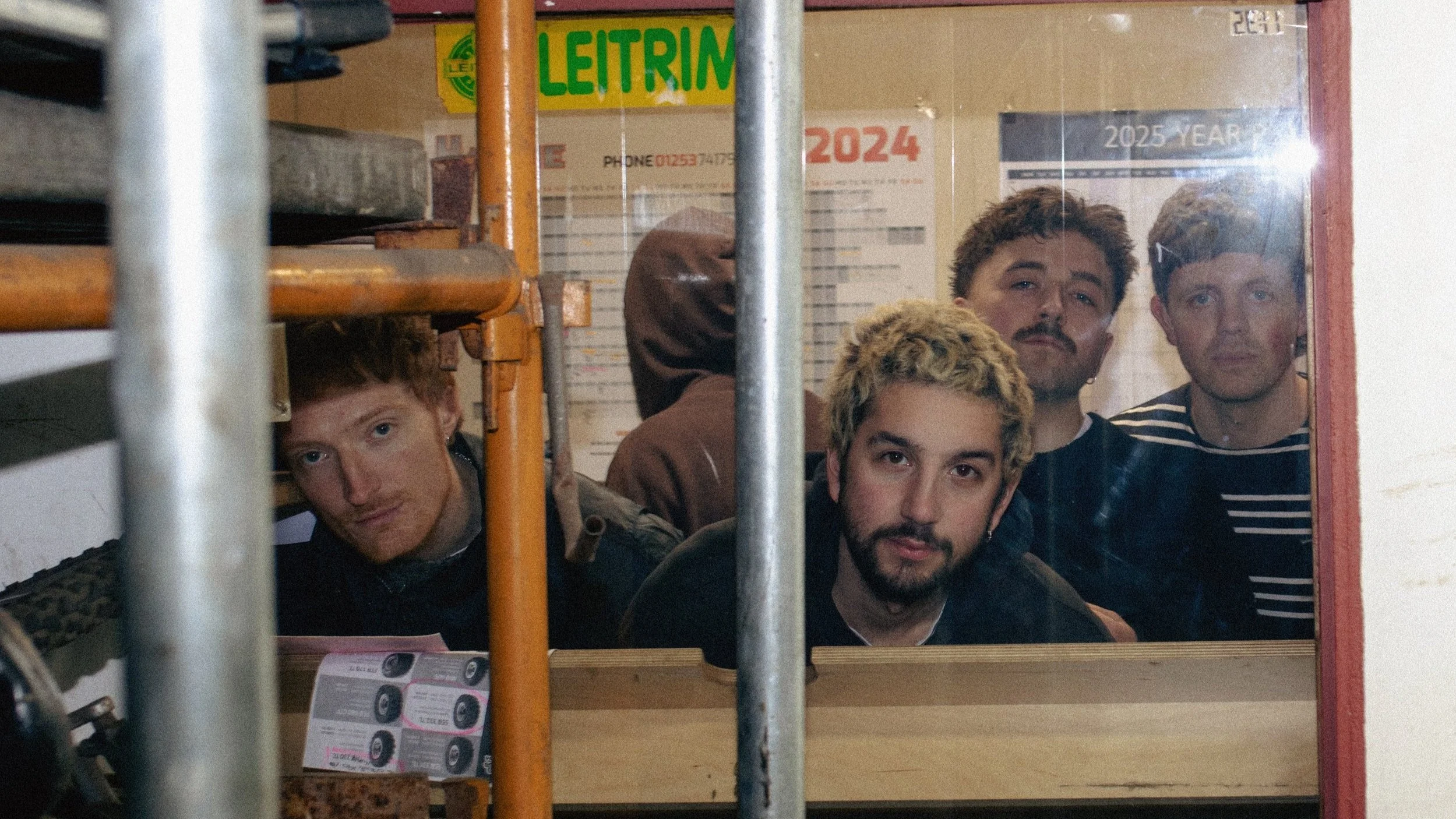
Photo: Megan Di Pinto
Humour had just played a sweaty, intimate show at Milton Keynes’ music festival Multitude, and the last thing frontman Andreas Christodoulidis probably wanted was to sit in a studio and chat, but he did joke that it meant he “didn’t have to clear the stage”. He sat down, fresh from an exhilarating set, and spoke to us about their debut album, Learning Greek, which lands on all formats this Friday via tastemakers So Young Records.
Your debut album is out next Friday. What can we expect from that?
Well, there’s a bit of what we’ve released already in there, but I’d say that the songs are a bit more structured and a bit more kind of catchy, and I think better. Louder, but also more melodic.
How do you think your sound has developed from your first ever song?
Probably exactly in that way. It’s become louder, but also more melodic at times, and I think a bit more sure of what it is.
Do you have any influences that you’ve pulled from at all?
Yeah, I mean, the funny thing is we would often get people coming up to us after shows and saying, ‘Oh, you guys sound like such and such band’. And then I wouldn’t have heard of them, but we would go and listen to them, and then we’d like it and try to sound like them. Like, Title Fight was a big one. Floral Green (2012) was a big influence for us.
What was the process like to write the album?
I mean, it took a while. Like, we probably wrote the first song on it about two years ago. And then, at that point, started to put together demos that were for an album.
How did you realise that it was going to be for an album?
We kind of wanted it to be and then, you know, the label So Young [Records] told us that we should start working towards an album because they’d like that to be the next thing that we release. So, yeah, we kind of had an inkling that it was going to be a full-length album at that point. But yeah, it took a while, we wrote loads of songs. We wanted to go into the recording studio with at least double the number of demos that there would be songs on the album, so we could narrow down.
Were you writing it to be like an album, cohesive in a way?
We weren’t writing with like a theme or anything in mind. It was just writing songs. We just thought at the time: whatever the best ones are, are going to be the ones on the album.
Did you pull from any real-life experiences?
Yeah, yeah. I mean, when I’ve been writing, it’s always been a mixture of real-life experiences and stuff I’ve read and other people’s stories that I’ve kind of tried to amalgamate into a narrative.
And then, about halfway through the writing of the album, there was a song that didn’t make the cut, but it just had a line about learning Greek, about how I wanted to get back to doing that. And that felt like a nice metaphor for finding out more about myself and remembering things from the past and bringing it forward.
I thought the album was starting to be a bit of a composition of memory and nostalgia and imaginary things, but also things that have happened. And Learning Greek felt like a nice way of explaining that, I guess.
Is that to do with your family?
So, my parents are Greek, but I grew up in Scotland and, you know, I have a lot of ties to Greece and I spent a lot of my childhood there and have fond memories. It felt like a nice way of recollecting the early memories and voices and bringing them forward again.
What made your parents move from Greece to Scotland?
For work. They chose Scotland because it’s a nice place.
I’ve only been to Scotland once! I’ve been meaning to go to Glasgow. I really want to get the sleeper train, but I think it’s 75 quid one way.
Oh yeah, the sleeper train! Don’t get the sleeper bus, that’s rough.
Sleeper bus? I’ve never heard of that.
You’re kind of on a hammock, and you can’t really sit up for the duration.
It sounds kinda… cool?
It’s kinda cool, but in most ways worse than just sitting.
How long does it take to get to London from Glasgow?
It’s like an eleven-hour bus ride.
It sounds incredibly nauseating.
Very much so.
You’re touring later this year, do you have anything planned for that?
I mean, just between now and then, we’re going to keep writing for whatever’s next, like the next album. But, yeah, just kind of improving the live show and working the new songs into the set.
Is there a particular tour date that you’re excited for?
Milton Keynes, obviously [laughs].
I mean, we do get a good crowd here. It’s also really weird that, like, Lizzo played here in 2014.
Really?
Yeah, I didn’t believe it when I first heard! Are there any fellow Glaswegian bands that you like at the moment?
Yeah, there are lots. It’s nice. We have a studio in a building where loads of other bands practice. So, in that building, there’s Vlure, Walt Disco, Conscious Pilot, a band called Gout, who are kind of a new metal hardcore band – very good. Yeah, there are lots of good bands in Glasgow. Good musicians. And it’s a nice mix of genres.
It seems like you have a really good music scene up there. Do you have a favourite song from the album?
I think we all have different ones. Mine is one called Dirty Bread, which isn’t out yet. It’ll be out on Friday.
What’s the meaning behind that name?
It’s a line from a traditional Greek song. And I always wondered what it was about when I was little, because I would hear it a lot, and my parents would play it.
I think it has a sort of metaphorical meaning and it was written during the military dictatorship. It was about the communists who were in the mountains eating dirty bread, suffering, but they were noble and they were to be revered for that reason.
It was written in code because they weren’t allowed to openly talk about that sort of thing at the time. And I always used to laugh at that line, and then, when I got older, my parents explained, ‘oh no, this is what it means’. I thought, that’s a nice thing to put in a song. And the song is about that sort of generation in Greece and my grandfather getting older and kind of the stuff he does as an old man, his day-to-day life.
Do you have a favourite song from the album to play live?
There’s one called I Knew We’d Talk About It One Day that I really like playing live. I don’t know — it’s just that there are some songs that are super hard to sing, and that one’s fairly easy, and it means I can just enjoy it. With the harder ones, although I’m enjoying them, I’m feeling a bit stressed about getting through it and not overdoing it or losing my voice. And that one’s just perfect.
You just relax?
I can relax… and it’s really nice.
Lastly, where did the name Humour come from?
It was quite a struggle coming up with a name.
A lot of them are taken nowadays.
A lot of them are taken, and just everything sounds shit when you’re trying to come up with a name. We had a few, and then our friend who sings on the album – she’s called Theo Bleak – she was having a look through the list that we had, and she had this great idea of searching synonyms for all the words that we had, one of which was humour. And we were like, ‘oh, that’s good’. It’s kind of ambiguous.
Learning Greek is out this Friday (8th) via So Young Records. Pre-order from Rough Trade here.