Charlotte MacInnes: Finding the whimsy in the wreckage
Charlotte MacInnes has spent the last five years turning big feelings into bigger music. With her debut EP ‘Highwater’ out now, she's finally letting the world in on the process.
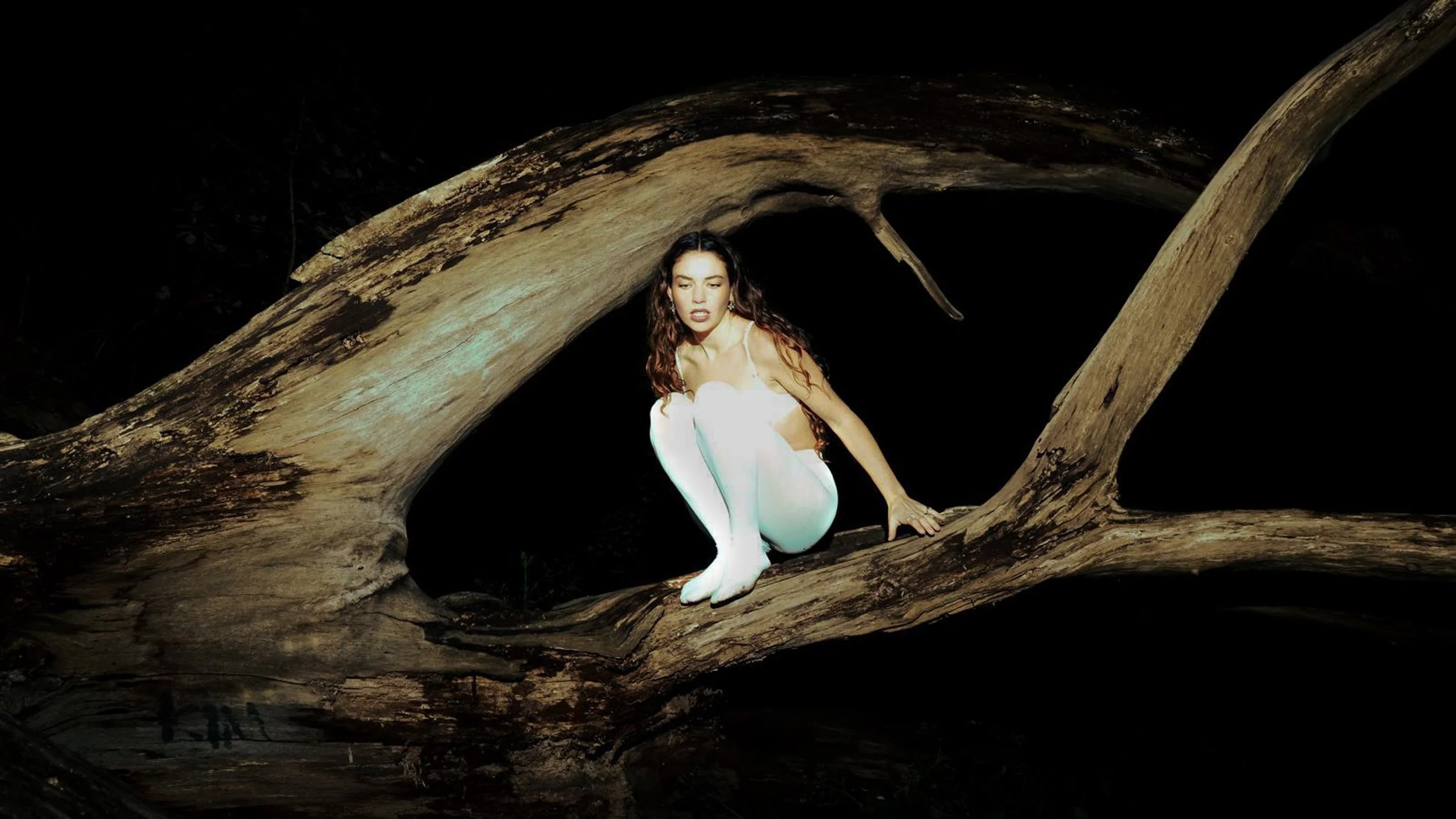
Photo: Press
There's a moment, about twenty minutes into talking to Charlotte MacInnes, when she disappears off-screen entirely and returns holding a small tin box stuffed with vintage earrings: one pair shaped like bunches of grapes, another like tiny chandeliers, and a tangled 50p necklace from a charity shop near her old flat. "You can tell a lot about a girl from her jewellery case," she says, tipping the lot out like treasure.
It's an apt image for an artist whose debut EP has been built from exactly that kind of accumulation. Small, glinting, half-buried things that mean more than they look like they should. Born in Australia but with deep Scottish roots, MacInnes has spent the last five years quietly turning those influences, memories and contradictions into song. Highwater, her debut EP, has been out since late June, and MacInnes is still somewhere between terrified and thrilled about it.
The EP’s been out for a few weeks now. How’s it feeling to have it out there?
It feels like the most obvious thing to do, because it's what I've been preparing for for the last five years. These are all the little pieces of art I've been weaving together. But at the same time, you remember how emotional and vulnerable it all is, how much you've bled into this music, and you're just like, “Hey world, here you go, you can have it now.”
Making a debut record feels like one of the most personal things you can do as an artist — as much about working out who you are as it is about the music itself. How did you figure out which version of yourself belonged on this EP?
That’s an amazing question. I think it’s figuring out who you are as an artist, but also which parts of who you are as a person you want to put a spotlight on. Every human is so multifaceted and complicated, and I think I realised how complicated I am throughout this process — but also how insanely big my feelings are. In a positive way, in a negative way, I just feel everything to its extremes, even about the most mundane things. I resort to really radical forms of excitement and optimism in my day-to-day, like “Everything’s going to be awesome, everything’s great.” But the music became, without really my knowledge, a place to put the heaviness of the other side of that. The yin to the yang of it. Without really planning for it to be.
You've described the EP as charting a cycle of losing yourself and finding your way back. Where does the listener leave you by the end of it?
In the order of the EP, it goes from the most lost to the most found. I wrote the tracklist out and I was like, “Wait, there’s a deep subconscious meaning here that I didn’t even plan.” So not found, I don’t know if I’ll ever be found. But there’s a resolution in the final song, Struck, where I literally say I’ll never be afraid to be alone again. It’s a pretty big promise to make to yourself. For this chapter of my life, I’m feeling relatively found. I don’t know, I like that term. I’m going to use it for everything now.
Struck feels so certain and declarative but Celestial is on the opposite end still asking questions — what if I can be bigger than my ghost? Did the EP move from uncertainty toward conviction, or the other way round?
Nothing is really linear. But Down to the River and Only Pretend were the first songs I wrote, quite a bit before the rest, and they are the most uncertain parts. One is really fragile, just trying to keep my head above water. The other is just angry and frustrated. So, thinking about it now, yes, I did kind of write them in a semi-order of resolution of the conflicts in my life.
And which song surprised you most emotionally when it came together?
Struck. I didn’t realise I was that defiant. People describe you to yourself sometimes and you’re like, “Really? That’s cool, but I didn’t realise that’s how you saw me.” I thought I was far more sensitive and vulnerable. And a lot of me was like, no, you are those things, but in the same breath you’re incredibly defiant. I was kind of thrilled about that. I was very pleased with my ability to practice what I preach.
Your SoundCloud describes you as whimsy and rage. On a spectrum between the two, where does Highwater land?
Oh, dang! Okay. I’m actually going to have to say rage, it would be 50/50, but if I had to say one, it’s 60/40 rage. Because I think that’s what made me discover that you can have whimsy within a world of rage and confusion and frustration and bizarreness and uncertainty. You can still have that whimsy. But the boiling point of all of that was when I was writing the music.
You’ve described it as feminine chaos as well. Something that makes a woman want to get on a horse and ride anywhere. Was that the intention from the start?
A hundred percent discovered, not planned. It was revealed to me like a book I didn’t know I was writing. I believe your subconscious knows so much more than you think it does. I was lucky to be in rooms where people were allowing me to explore that side of myself, and I never walked in going, “We need to write a song about A or B or C”. I’d go in asking, “Where am I lying today in myself?” And we’d make some noises and the noises would become words. That very much happened with a song called Beast — it sort of fell out, and the meaning unraveled as we wrote the rest of it. It’s chaotic, but it makes me feel really excited.
You’ve written with Ashnikko and Amanda Ghost on this record, both seriously strong voices. How do you stay the author of something when that many people are inside it with you?
They are incredibly respectful. I think all good collaborators are so respectful of your voice and where you’re at in that moment. It’s a very fine art, sitting alongside a person who’s writing a version of their story through music. But I also know where my strengths lie, and sometimes I feel like I trust the people I work with so much that I’m like, “Take the reins for a bit. I’ll ride over here. And if it stops feeling like me, I’ll let you know.” It’s not really friendship, and it’s not really a business relationship. It’s this third thing, like a creative partnership. I can’t even really explain it. It’s so special, I’d recommend it to anyone.
You’ve said before that you’d write until you physically couldn’t cry or yell any more. Is the music still doing that work for you?
Absolutely. Especially when you don’t know what you’re feeling that day – you’ve had a weird morning, traffic was crazy, whatever – and you have to find a way to zone into something that requires you to be totally present. When you really feel that, it is completely therapy. It sounds so corny, but I’d end up writing something and just feel so different after. I think it’s something we’re meant to do. Express things, verbalise things, dance, instead of just shutting down when you’re overwhelmed with feeling. I feel very fortunate to have something to put big feelings into.
The EP feels like it carries a lot of personal relationships in it. Which track makes you most proud right now?
At the moment, Down to the River. The words are really simple and more conversational than a lot of my other lyrics. The second verse is one of the only things I’ve written that’s just exactly what I mean — it’s not metaphorical. I write a lot of introspective, grand metaphors, which I love, that’s my favourite thing to do. But this, I tapped into something so pedestrian, and for some reason that hits even harder sometimes. I write about my two best mates in it, and I spoke to one of them last night. He hadn’t heard the song in a while and I got so emotional just being like, “I made this for you.” It’s a very Australian thing to not be overly emotional or self-indulgent about stuff like that. So, when you are, it’s just like “Here you go. Enjoy.”
You used to carry poetry books everywhere. Do they still find their way into the songwriting process?
I go through phases with it, but yes. Even if you open a page and think, that’s terrible, I hate it. It still gives you a visual. Or you read something incredible and it spirals into something completely different, and the song is never about that in the first place. You just needed to read that to get to this. I’m also really obsessed with an Instagram page called Poetry Is Not A Luxury. Anytime that comes up I’m screenshotting constantly.
There are Celtic threads running through the record. Your dad's from Orkney, right? How much of your musical identity do you think comes from that heritage rather than growing up in Australia?
So heartily rooted in that. My father is constantly playing Scottish music. He lived in Britain in the seventies and eighties. The female Celtic singers always spoke to me the most. It’s like the most subtle version of incredible levels of emotion, and I think Celtic music does that better than anything. If you see me walking down the street with headphones on bopping, it’s definitely something Gaelic.
I'm from Scotland, and it's beautiful. If you ever make it up there, you have to go to a ceilidh. It's basically a dance and a party, which feels very on brand for you.
A dance and a party, yeah! And – okay, this is a bit mad – my mum nearly called me ceilidh. Like, after the word. But she was like, the Australians are going to struggle to spell that. So, I was Cece in the womb until I was born and then they landed on Charlotte. Ceilidh would have been a genuinely excellent name though. Maybe I’ll save it for something else.
A few minutes later she's rummaging through the box again, producing another treasure and another story. It feels like a neat summary of Highwater: a record built from fragments, memories and moments that might seem insignificant on the surface but reveal their value when held up to the light. Like the jewellery case itself, it's full of small things that glint.
Highwater is out now via Atlantic Records.